
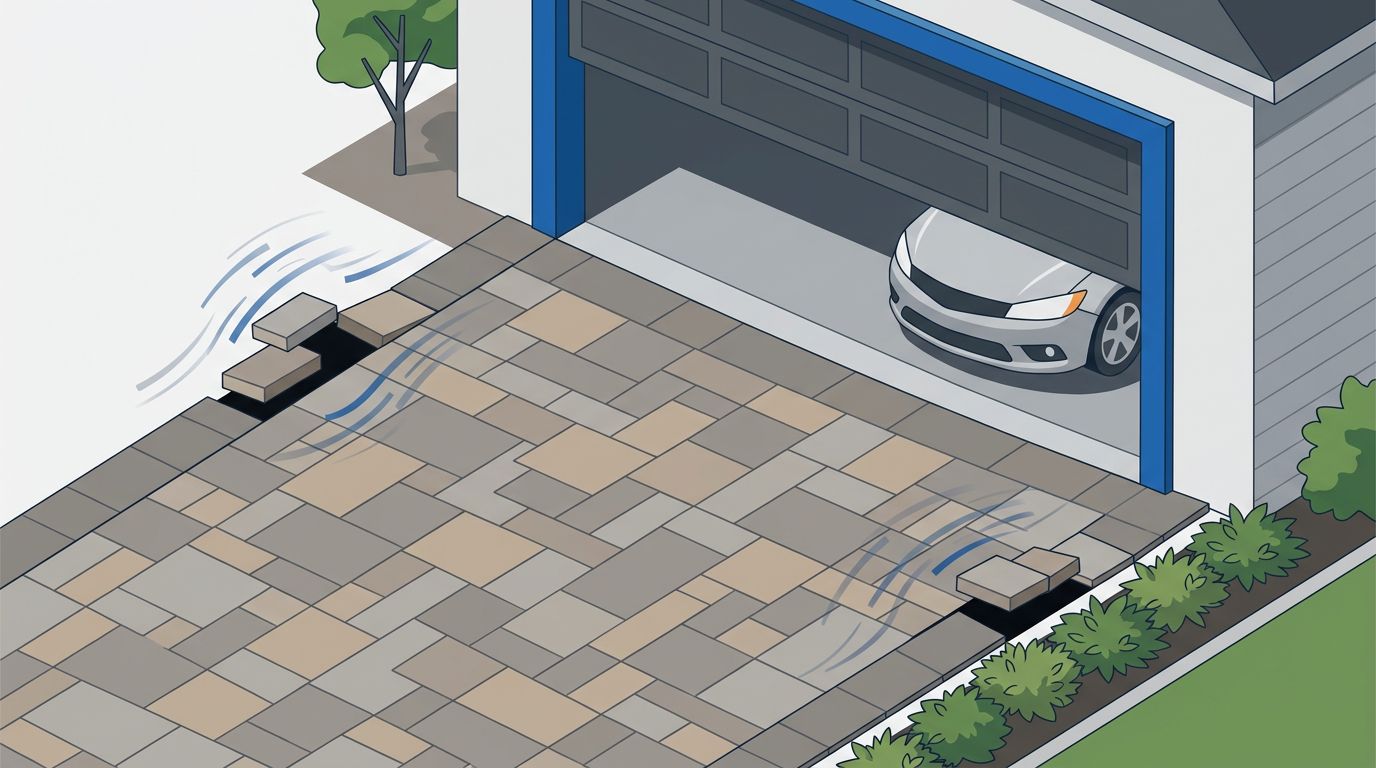
I often notice that paver edge spreading appears at garage entrances before anywhere else on a property. The edge may look stable for a long time, but eventually, the joints begin to open, the outer row of stones drifts outward, and the entire driveway perimeter starts to look worn and neglected.
This movement is not random. Whether you have installed interlocking pavers or traditional concrete pavers, these surfaces are highly susceptible to shifting in high-traffic areas where vehicles frequently turn, brake, and put weight on the garage threshold. Once the edge loses its structural support, it continues to give way, slowly moving further out over time.
Key Takeaways
- High-Stress Zones: Garage entrances are the most common site for edge spreading because turning tires and vehicle weight exert constant lateral pressure on the outer paver rows.
- Restraint Failure: The primary cause of shifting is inadequate or degraded edge restraints, which allow the perimeter stones to creep outward over time.
- Water Infiltration: Poor drainage and gutter runoff saturate the bedding sand and base material, weakening the foundation and accelerating the separation of pavers.
- Early Intervention: Minor gaps, uneven joints, or a shifting border are early warning signs that require professional repair before the entire system loses its structural integrity.
- Root-Cause Repair: Simply filling surface gaps is ineffective; lasting repairs require excavating the edge, rebuilding the base, installing robust restraints, and using polymeric sand.
The garage entrance takes the hardest hit
A garage entrance is rough on pavers because tires rarely move in a perfect straight line. They turn, scrub, and push sideways, and the significant vehicle weight creates intense stress points every time someone swings into the driveway at an angle or backs out with the wheels turned.
That side pressure matters. Straight driving is one thing, but turning a vehicle on a paved surface creates outward pressure that gradually shifts the driveway edging over time. This force continuously impacts the same small area, slowly pushing the stones away from the apron.
I also see this happen faster when the driveway is used every day. One car might not do much, but two cars, delivery trucks, golf carts, and repeated stop-and-go movement wear down the edge much quicker. If the garage apron sits at a slight slope, the load becomes even more uneven. Think of the edge by the garage like the hinge on a door. Proper lateral confinement is essential to prevent this hinge effect, as it keeps the entire system locked in place so that the outer rows do not begin to shift and loosen.
Weak edge restraint is often the real problem
People often blame the pavers themselves, but the real issue is usually what is holding them in place. Pavers need reliable edge restraints, which serve as the primary defense in maintaining the structural stability of your driveway. Without them, the outer row has room to creep outward every time a tire pushes against it.
That restraint can fail in a few ways. It might be that plastic edging was installed improperly, metal edging has buckled, or concrete edge restraints have simply cracked over time. Sometimes, the base at the edge was not compacted tightly enough, meaning the border had a weak spot from day one. Once that happens, the pavers do not need a dramatic event to move; daily use is enough to compromise the entire system.
Here’s what that looks like when the edge starts to give way.
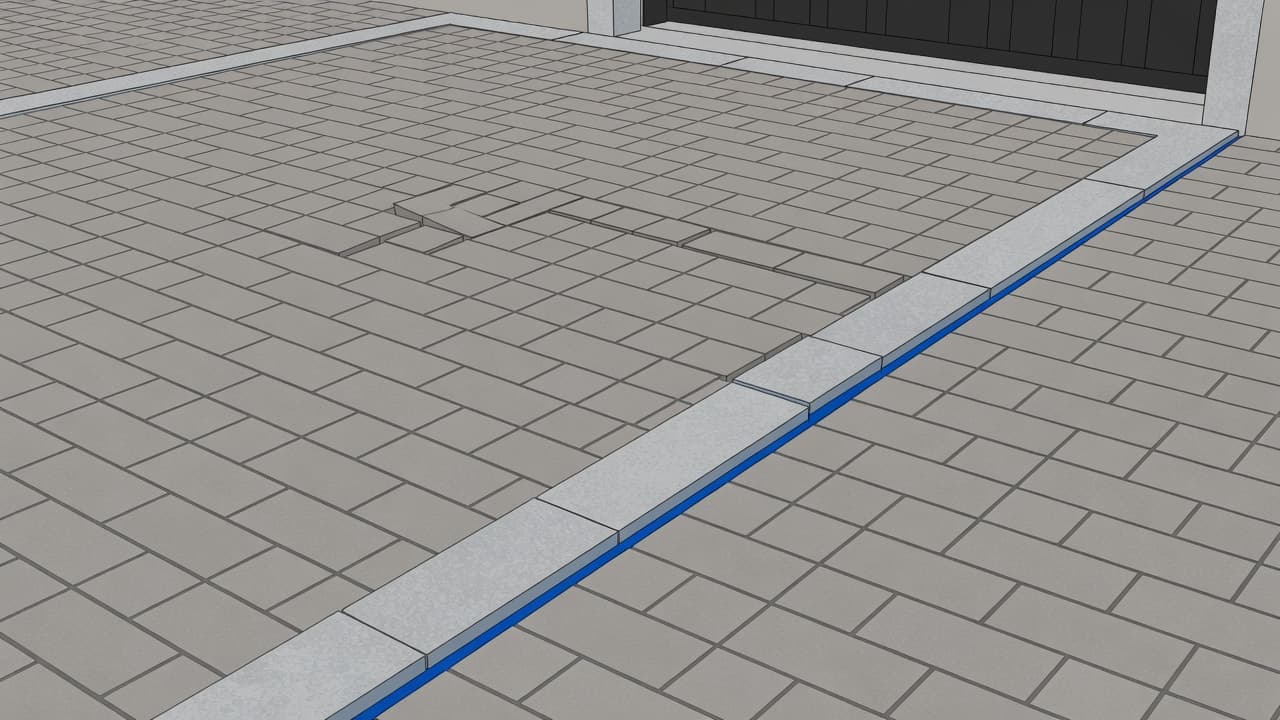
A loose border is often a sign of a deeper support problem, not just a small cosmetic gap.
Once the restraint goes soft, the row starts to fan out. The pavers may still sit flat at first, so the damage looks minor. To prevent this, effective spike anchoring or high-quality cementitious edging is necessary for lasting support. Even natural stone borders require similar reinforcement to ensure the system stays locked in place. If these measures are neglected, the gaps will widen and the line will shift, turning a small maintenance task into a major repair.
Water and soil movement keep pushing the edges out
Water is the quiet part of this story, and it does more damage than most people realize. Rain, irrigation, runoff from the roof, and wash water all work their way into the joints and the base below. When that base gets wet, it loosens due to constant soil movement. In colder climates, these issues are compounded by freeze-thaw cycles that expand and contract the ground, pulling support out from under the edge and causing the pavers to shift.
Florida makes this worse. Heat, humidity, heavy storms, and sandy soil all give the pavers more chances to move. A driveway that looks stable in dry weather can start to wander after a few wet weeks.
Gutters matter here too. If water dumps near the garage entrance, it washes at the same edge every time it rains. I see the same thing when roof cleaning or gutter cleaning gets ignored for too long, because dirty runoff and overflow continuously seep into the paver joints. This persistent saturation eventually washes away the bedding sand that provides the necessary friction and stability for your driveway.
Pressure washing can add to the issue if it is done too aggressively. A hard blast aimed directly at the surface can displace the locking sand found within the paver joints. A soft wash is the better choice for delicate surfaces like roofs, while pressure washing should stay controlled on hard surfaces. Too much force is a quick way to turn a small maintenance job into a loose edge.
Small signs that paver edge spreading has started
Recognizing the warning signs of edge failure is the best way to evaluate the overall hardscape performance of your driveway. If I walk an area and notice these specific indicators, I know the border needs professional attention before the damage becomes extensive:
- The outer row of interlocking pavers is no longer perfectly straight.
- Gaps are noticeably wider near the garage than farther down the driveway.
- Joint sand keeps washing out after rain or routine cleaning.
- One paver sits slightly higher or lower than the adjacent unit.
- The edge creates a slight lip or trip hazard at the garage threshold.
- The border pavers feel loose or shift when walked on.
Many homeowners miss these early warning signs because the movement happens very slowly. One day the paver joints look a little open, but a month later, the outer row has shifted enough that the misalignment catches your eye every time you pull into the garage.
The trick is not waiting for a full structural collapse. Once the border begins moving, it rarely corrects itself. The gap you see on the surface is usually only a small part of the underlying story.
How I repair and prevent it from coming back
The right fix starts below the surface. I do not trust a quick patch when the edge is already moving. My professional installation guide focuses on repairs that hold up to tire pressure, water, and time.
A proper repair usually follows this order:
- Remove the loose pavers at the edge.
- Perform thorough base preparation by excavating and rebuilding any soft or sunken spots.
- Install a fresh, compacted gravel base to create a firm foundation.
- Install or repair the edge restraint, such as replacing damaged plastic edging or metal edging to keep the perimeter locked in place.
- Reset the pavers in line, ensuring they sit firmly on the bedding sand layer for long-term structural stability.
- Refill the paver joints with high-quality polymeric sand to lock the units together and prevent weed growth.
- Seal the surface if it is a good fit for the material and condition.
That last step matters, but it is not magic. Driveway sealing helps protect the surface, makes cleaning easier, and slows down sand loss. It does not replace a solid base or a strong edge restraint. If the foundation is weak, sealing only covers the problem.
Whether your driveway edging consists of standard hidden restraints or decorative natural stone borders, the key is maintaining constant pressure against the pavers. I also like to keep the area clean after the repair. Dirt, algae, and grime hide movement fast. A clean surface makes it easier to spot new gaps before they become a bigger mess.
If the edge has already shifted and you want it looked at before it gets worse, Get a Quote.
Why cleaning still matters after the repair
Regular maintenance is essential for longevity, whether you have concrete pavers or porcelain pavers installed. Cleaning does not hold pavers in place by itself, but it helps significantly. I can see loose joints, cracking, and border movement much faster when the driveway is clean. That matters because a stained surface can hide the first signs of trouble.
I still use pressure washing on hard surfaces when the job calls for it, but I keep it controlled. Too much pressure can strip out the sand in your paver joints, which often contradicts the recommendations found in a professional installation guide for maintaining edge integrity. Around pavers, less force is often smarter than more force to ensure the structural base remains undisturbed.
For roofs, I prefer roof cleaning methods that fit the material, and a soft wash is often the safer choice. That keeps the roof clean without blasting debris into the driveway every time it rains. When gutters are clear, water moves where it should instead of pouring out near the garage and chewing up the edge.
A clean driveway also makes driveway sealing look better and last longer. The surface sheds dirt more easily, the joints stay easier to watch, and the whole entrance looks cared for instead of patched together.
Frequently Asked Questions
Why does my paver edge only move at the garage entrance?
This area experiences the highest levels of lateral stress from vehicle tires turning, scrubbing, and braking. Because this force is applied consistently to the same spot, it eventually overcomes the edge restraint if the perimeter is not perfectly reinforced.
Can I just fill the gaps with more sand to fix the spreading?
Filling the gaps with sand is merely a cosmetic band-aid and will not stop the spreading. Because the movement is caused by a failing foundation or weak edge restraint, the pavers will continue to shift outward until the underlying structural support is properly repaired.
Does pressure washing cause paver edges to fail?
Aggressive pressure washing can damage your driveway by stripping out the joint sand that provides friction between stones. When too much sand is removed, the stones have more room to shift, which weakens the entire interlocking system and compromises the edge.
How can I tell if my edge restraint is failing?
Look for subtle indicators such as an outer row that is no longer straight, gaps that are wider than elsewhere in the driveway, or individual stones that wobble when you walk on them. If you notice a ‘lip’ or trip hazard developing at the garage threshold, your edge restraint has likely already lost its grip.
Conclusion
Paver edge spreading near garage entrances typically begins with high pressure, followed by water infiltration and inadequate support. The outer row of concrete pavers bears the brunt of the damage because it must withstand the constant load from turning tires and frequent vehicle traffic.
Once this border begins to shift, the most effective solution is to address the root cause rather than simply filling the gap. Installing robust edge restraints and ensuring you have a properly compacted gravel base will significantly increase the longevity of your driveway compared to waiting for the entire perimeter to drift.
Remember that the first signs of trouble are usually subtle. By the time paver edge spreading becomes obvious to the naked eye, the movement has already been compromising the integrity of your hardscape for some time. Stay proactive, monitor your edges regularly, and address small gaps immediately to keep your investment secure.