
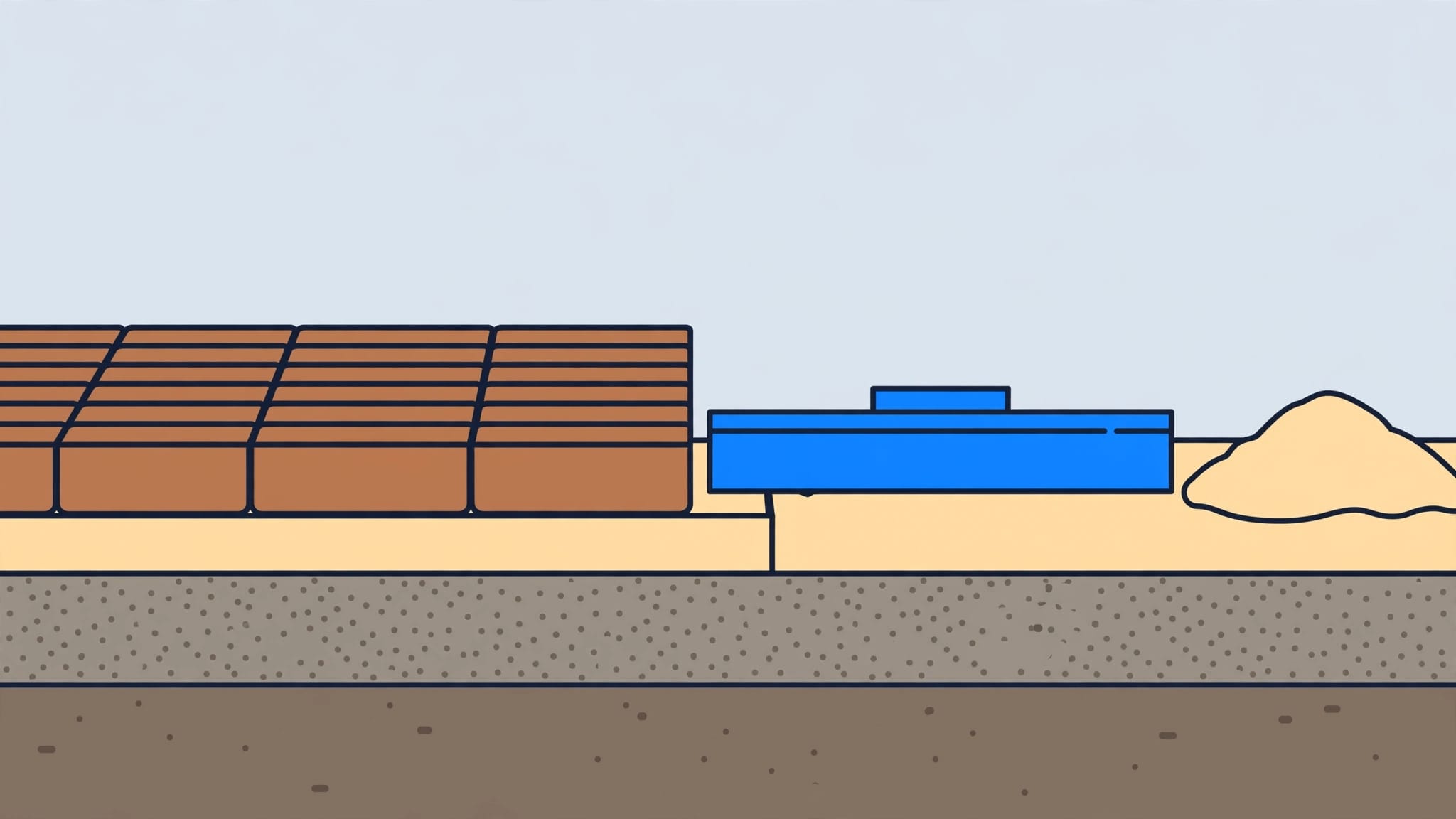
The aggregate base layer is compacted to provide support. A loose layer of bedding sand, about 1 inch thick, is screeded above the compacted base, and joint sand fills the paver gaps afterward.
I recommend getting the support right before buying sand. A thicker bedding layer won’t repair a weak base, and your patio’s square footage determines how much material you’ll need.
Key Takeaways
- Use properly graded concrete sand for conventional paver bedding.
- Compact the aggregate base, then leave the screeded bedding loose until pavers are installed.
- Order bedding sand separately from joint sand.
Which Sand Belongs Under Brick Pavers?
Choose concrete sand by specification
I recommend clean, washed sand sold as concrete sand. C-33 sand should meet ASTM C33, which controls particle grading and limits excessive fines.
Ask for “washed ASTM C33 concrete sand for paver bedding.” A supplier’s “paver sand” label alone doesn’t establish that specification. For conventional bedding, install paver sand that meets the specification, not fine mason sand or play sand.
Keep bedding and joint materials separate
Bedding sand sits beneath the pavers. Polymeric sand, also called jointing sand or joint sand, contains binding additives and fills the gaps between installed pavers. These materials aren’t interchangeable.
ASTM No. 9 stone is another specified setting material, but it belongs in a compatible installation system. Don’t substitute it casually into a conventional sand-bed assembly.
How to Screed Bedding Sand for Pavers
Prepare firm support and drainage
Alliance’s Gator Supersand G2 specifications limit the bedding layer to 1 inch. Its traditional assembly calls for at least 6 inches of compacted 0-to-3/4-inch crushed stone over Gator Fabric GF4.4, with a minimum 2% surface slope.
Compact the aggregate base in lifts with a plate compactor. That slope equals about 1/4 inch per foot. Establish it in the base instead of creating it with uneven sand.
Vehicle loads and soil conditions affect the supporting assembly. My paver driveway base depth guide explains those differences.
Screed, measure, and seat the pavers
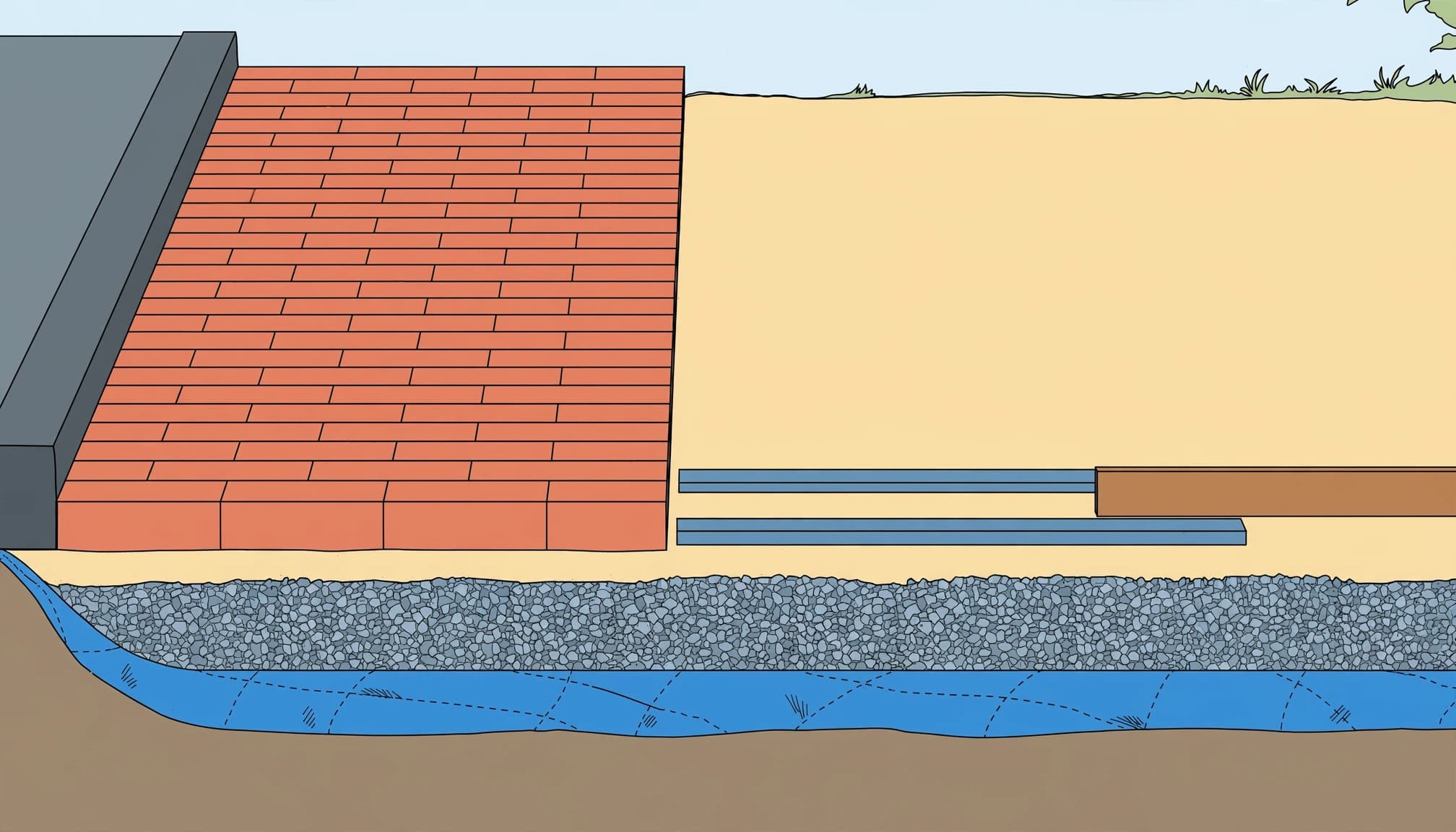
Alt text: Bedding sand being screeded between rails before brick pavers are laid.
- Set two screed rails on the finished base, using their outside diameter to establish bedding thickness.
- Spread paver sand as a loose, consistent layer, then draw a straight board across both rails.
- For adjoining runs, reset the screed rails to maintain the same bedding depth. Remove the rails and fill their channels without disturbing the surrounding bed.
- Measure the depth at exposed edges and several small test openings. Restore those openings before laying pavers.
Keep people off the screeded surface. Leave the bedding loose, lay the pavers, secure the edges, then seat the installation with a plate compactor or other suitable equipment, following the system’s instructions. Don’t pre-compact loose bedding unless the specified system requires it.
How Much Sand Should You Order?
I calculate bedding volume as square feet × depth in inches ÷ 12. Divide cubic feet by 27 for cubic yards.
For 200 square feet at 1 inch, 200 × 1 ÷ 12 = 16.67 cubic feet. Divide 16.67 by 27 for about 0.62 cubic yard.
These quantities assume a uniform 1-inch layer.
| Patio area | Cubic feet | Cubic yards |
|---|---|---|
| 100 square feet | 8.33 | 0.31 |
| 200 square feet | 16.67 | 0.62 |
A 100-square-foot patio needs roughly one-third of a cubic yard. Allow about 10% extra for handling losses, rather than increasing the installed thickness.
A bag labeled 0.5 cubic foot covers 6 square feet at 1 inch. A 200-square-foot patio needs about 34 such bags before waste.
C-33 sand commonly costs $25 to $50 per ton. Mason sand runs roughly $30 to $85 per ton, but its price doesn’t make it suitable bedding.
Dry sand weighs approximately 2,500 to 2,900 pounds per cubic yard. Wet sand can exceed 3,000 pounds, increasing the weight purchased for the same volume.
A $12 to $31 material allowance for 200 square feet is a low-end estimate. Using the dry weights and C-33 sand prices above gives about $19 to $45 before waste.
A delivery fee commonly adds $50 to $150, and suppliers often have an order minimum of 1 to 3 tons. Those charges can exceed the sand cost. Check whether the order minimum exceeds your project need.
Bagged play sand costs around $4 to $6 per 50-pound bag, equivalent to $160 to $240 per ton. That comparison illustrates bagged pricing, not a recommendation to use play sand.
Finish the Joints With the Right Product
After seating the pavers, sweep compatible joint sand, also called jointing sand, into the paver joints and compact as directed. For the polymeric products discussed here, provide at least 1-1/2 inches of joint depth and finish approximately 1/8 inch below the paver surface or chamfer.
The pavers and joints must be dry before polymeric sand installation. SRW’s SimplyTough instructions require waiting 24 hours after rain.
Remove all surface residue before watering. Activation methods differ:
Alliance G2 sands require a shower lasting at least 30 seconds per 30 square feet. SEK PolySweep’s activation method uses 3 to 4 light mistings, approximately 5 minutes apart, on sections up to 500 square feet.
I wouldn’t apply one product’s watering method to another.
Common Bedding Sand Questions
Can pavers go directly on dirt?
For a permanent conventional patio or driveway, prepared soil alone doesn’t provide the required assembly. Pavers need compacted aggregate support, consistent bedding, drainage, and secure edges. Sand alone won’t reliably support vehicle traffic.
Can extra sand fix sinking pavers?
Adding a thick sand patch can leave the same problem underneath. Remove failed material, correct concentrated runoff, and rebuild the aggregate in compacted layers before resetting pavers.
My guide to repairing sunken brick pavers covers that base-first approach.
Can new polymeric sand cover old joints?
Don’t spread a thin cap over contaminated or failing material. Remove enough old fill and debris to provide the clean joint depth required by the replacement product. Joint-sand quantity depends on paver dimensions, joint width, and depth.
Start With Support That Lasts
A consistent bedding layer gives your pavers an even setting surface. Firm base support and proper drainage keep that surface dependable over time.
I recommend addressing movement before driveway sealing or pressure washing. For professional cleaning and sealing of stable pavers, Get a Quote from Kingsway.