
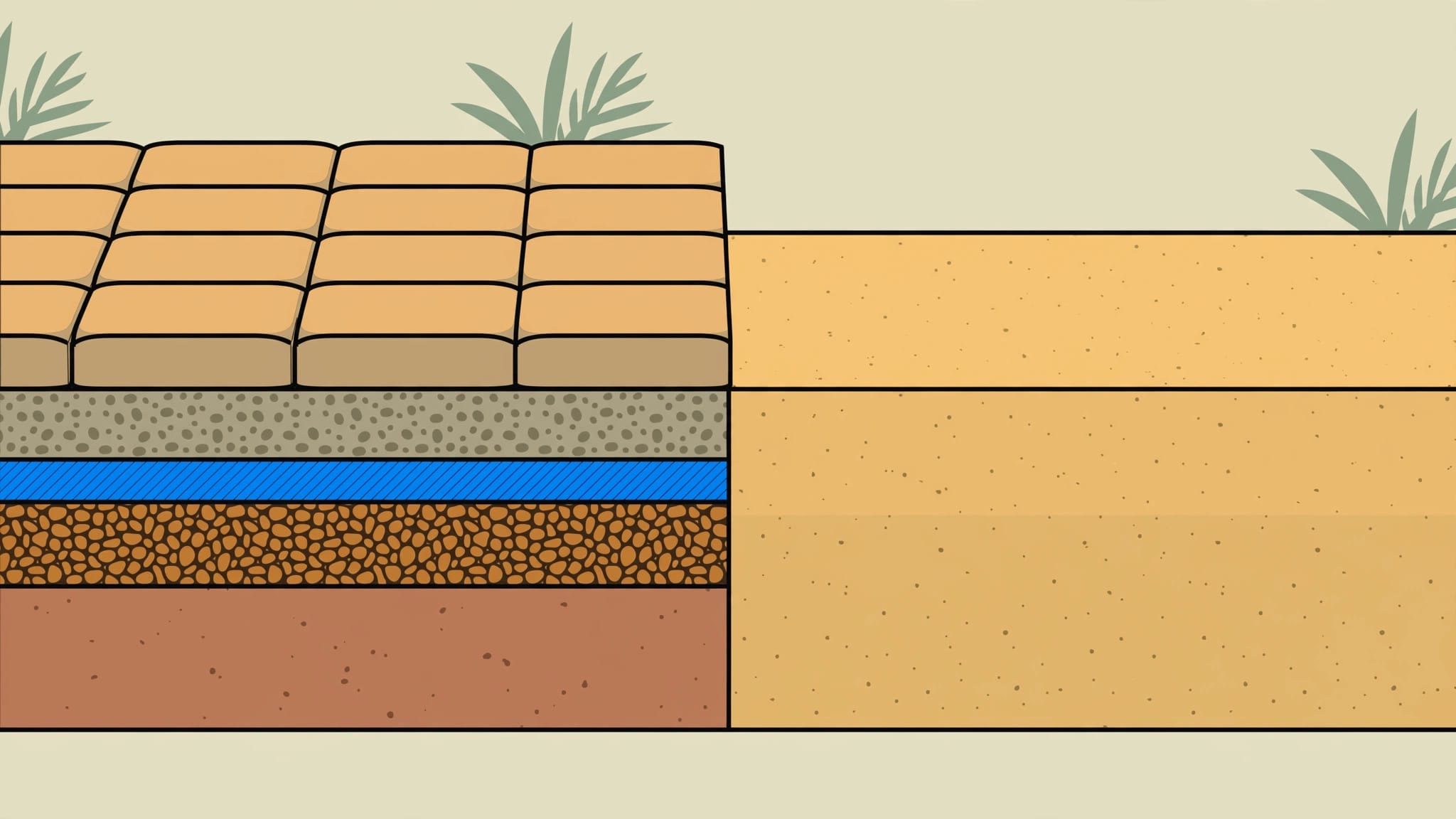
Geotextile fabric is recommended under pavers on clay or weak soil, but stable, well-drained sand may not need it. I recommend choosing fabric based on soil conditions, rather than adding it automatically to every Florida patio or driveway.
The right material keeps native soil and base gravel apart. Start with the ground beneath your pavers, then plan the supporting layers.
Key Takeaways
- Use construction-grade non-woven geotextile where clay or weak soil could mix with the base.
- Stable, well-drained sandy sites may not justify the extra expense.
- Fabric supports proper construction, but it can’t replace compaction, drainage, or secure edges.
When Geotextile Fabric Helps Under Pavers
Clay and weak soil need separation
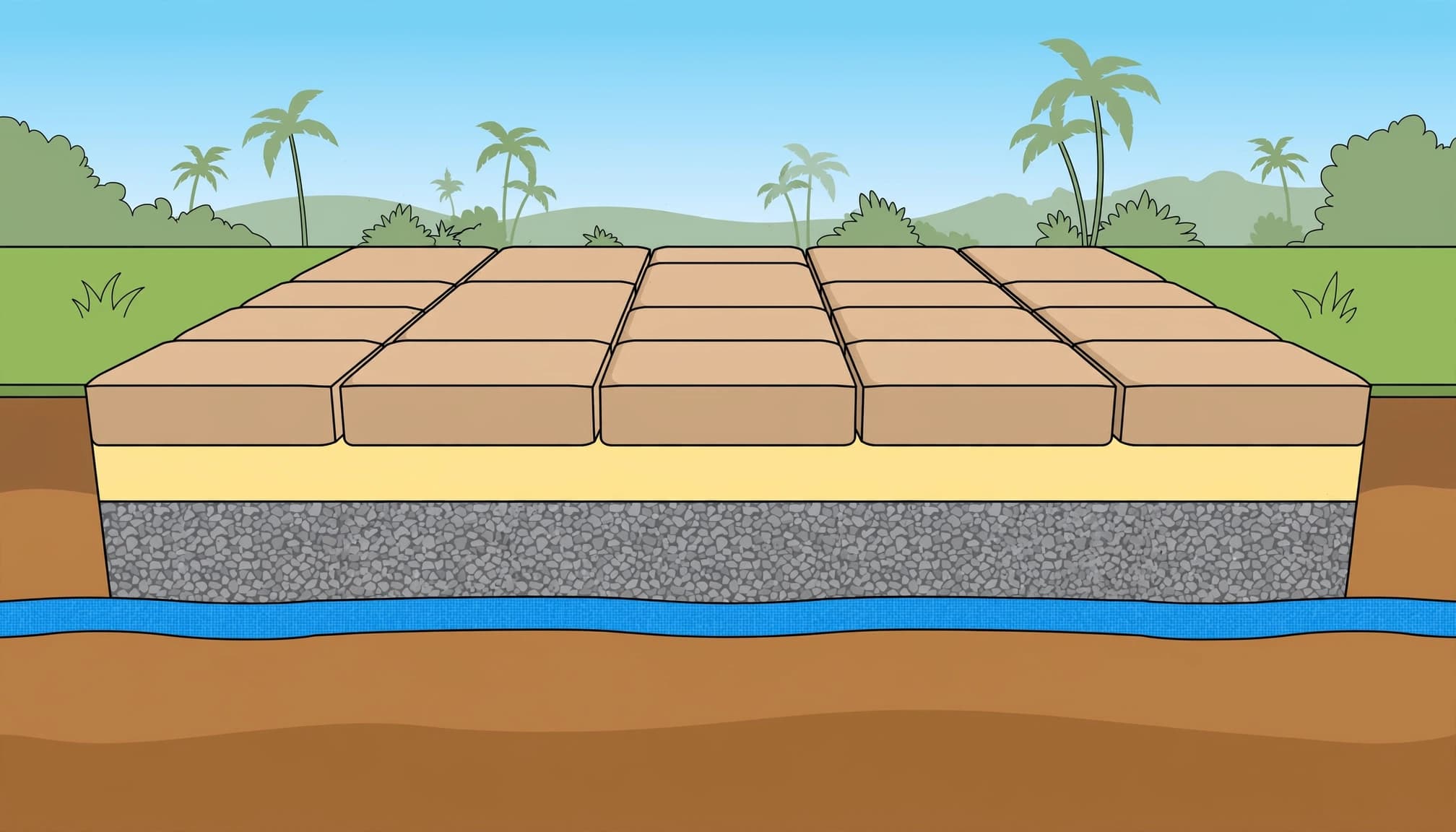
Geotextile keeps fine particles in clay soil from migrating into the aggregate and weakening support. Keeping the layers apart helps reduce sinking or rutting.
US Fabrics describes ICPI’s recommendation for clay soils as calling for fabric in all clay-soil applications. I recommend construction-grade non-woven material for separation and drainage. Soft, muddy ground still needs removal or appropriate treatment before rebuilding.
Stable sand may not need fabric
Firm, well-drained sandy soil may support a conventional paver base without fabric if the base is properly prepared. The choice depends on soil conditions, not simply on being in Florida.
Dampen exposed soil and squeeze it. Gritty material that falls apart suggests sand; sticky material that forms a ribbon suggests clay. This is an initial screen, not an engineering assessment. Persistent ponding, muddy footprints, or disturbed backfill deserve attention. Proper paver patio grading remains necessary with either soil type.
Non-Woven, Woven, and Geogrid Have Different Jobs
Non-woven usually suits separation and drainage
Non-woven geotextile is felt-like and permeable. Woven products generally offer higher tensile strength but much slower drainage. ICPI’s aggregate-base construction specification allows either type when its requirements are met.
I favor construction-grade non-woven fabric for this soil-to-aggregate application. The Ultimate Deck Shop recommends 4 to 8 oz material rather than products under 4 oz. Thin landscape fabric marketed as a “weed barrier” can tear, clog, or restrict drainage.
Pouring a pail of water through a filter fabric sample provides a quick permeability screen. Immediate flow-through gives only a rough indication of permeability, not proof of long-term filtration performance.
Geogrid provides reinforcement
Biaxial geogrid supports base stabilization and edge-restraint designs; uniaxial geogrid anchors a segmental retaining wall.
Western Interlock demonstrated woven fabric bridging a void beneath compacted gravel. Its separate four-layer biaxial geogrid test held its shape while an unreinforced box settled. These demonstrations show different functions, not a universal installation prescription.
Fabric Roll Options and Approximate Cost
Sandbaggy’s 8 oz non-woven polypropylene lists 205 lb tensile strength and a flow rate of 110 GPM per square foot.
Its roll options include these sizes.
| Roll size | Coverage | Fabric |
|---|---|---|
| 3 x 50 ft | 150 sq. ft. | 8 oz non-woven polypropylene |
| 30 x 300 ft | 9,000 sq. ft. | 8 oz non-woven polypropylene |
The smaller format suits residential-scale purchasing; wide rolls reduce seams on larger projects.
Approximate price estimates run from $44 for smaller rolls to $99 for a 150-square-foot roll. That $99 figure equals about $0.66 per square foot before overlaps and waste. These figures cover fabric alone, not excavation, aggregate, or installation.
How to Install Geotextile Under Pavers
I recommend planning the complete assembly before digging. These steps describe a conventional aggregate-base installation, not a permeable-paver system.
- Call 811 before excavation. Allow roughly 8 to 12 inches below finished paver level where the assembly requires it, extending excavation at least 6 inches beyond the border. Calculate depth using base, bedding, and paver thickness; vehicle loads may require more support.
- Remove roots, organic material, and failed soil. Compact the subgrade with a plate compactor where appropriate, then establish a 1 to 2 percent slope away from structures toward a suitable outlet.
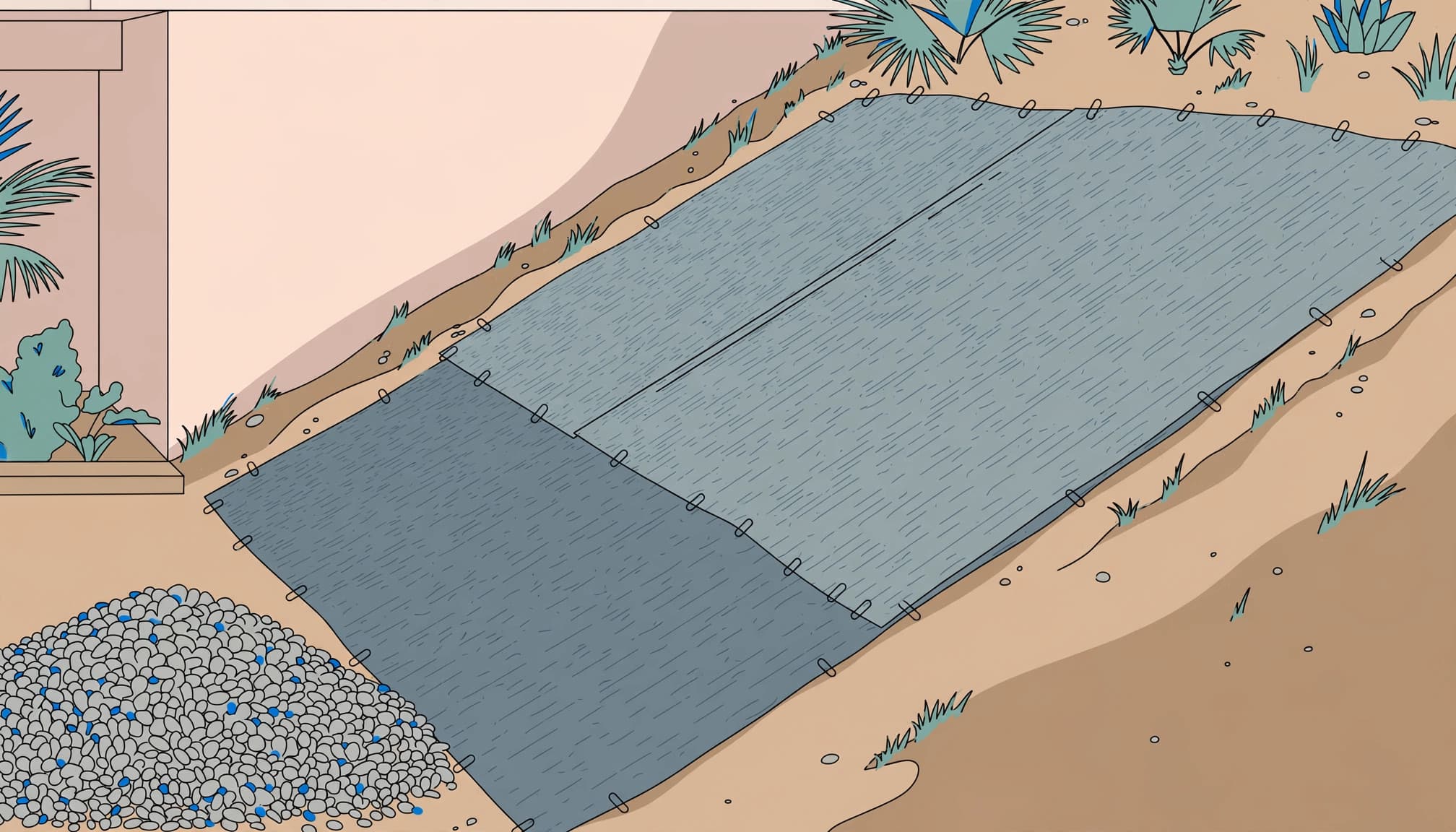
- Lay paver underlayment fabric, the geotextile layer, over prepared soil beneath the aggregate. Smooth out wrinkles. Published overlap guidance ranges from a 6-inch minimum to The Ultimate Deck Shop’s 12 to 18 inches, pinned every 3 feet. I favor the wider overlap for typical homeowner projects. Carry fabric up excavation sides where needed to keep the soil and aggregate from mixing.
- Protect fabric from prolonged UV exposure and cover it promptly. A common pedestrian paver base uses 4 to 6 inches of compacted 3/4-inch-down crushed aggregate, placed in 2-inch lifts. Compact each lift with a plate compactor. Crusher dust belongs only in assemblies that specify it; clean stone requires a different design.
- Screed approximately 1 inch of coarse concrete bedding sand. Lay pavers, secure edges, and complete final seating and compatible joint filling. Use polymeric sand only where appropriate. Bedding sand sets paver height; it doesn’t replace missing structural base.
Common Questions About Fabric Under Pavers
Does fabric go between gravel and bedding sand?
For a conventional installation, geotextile normally belongs between native soil and aggregate. Don’t add another layer beneath bedding sand unless the specified assembly requires it. Permeable systems have separate requirements.
Can fabric fix existing sunken pavers?
Fabric can’t lift a settled surface. Lift affected units, remove failed support, correct drainage, and rebuild compacted layers. During sunken paver repairs, preserve the existing soil-to-aggregate layer or replace damaged sections as part of the rebuilt assembly.
Protect the Base Before Protecting the Surface
Choose geotextile for the soil conditions, then build firm, properly drained support. I recommend completing structural repairs before pressure washing or driveway sealing.
Schedule nearby roof cleaning or soft wash work before sealing so rinse water doesn’t reach the fresh finish.
For professional paver cleaning and sealing in Southwest Florida, Get a Quote. Kingsway can help clean and protect your finished pavers.