
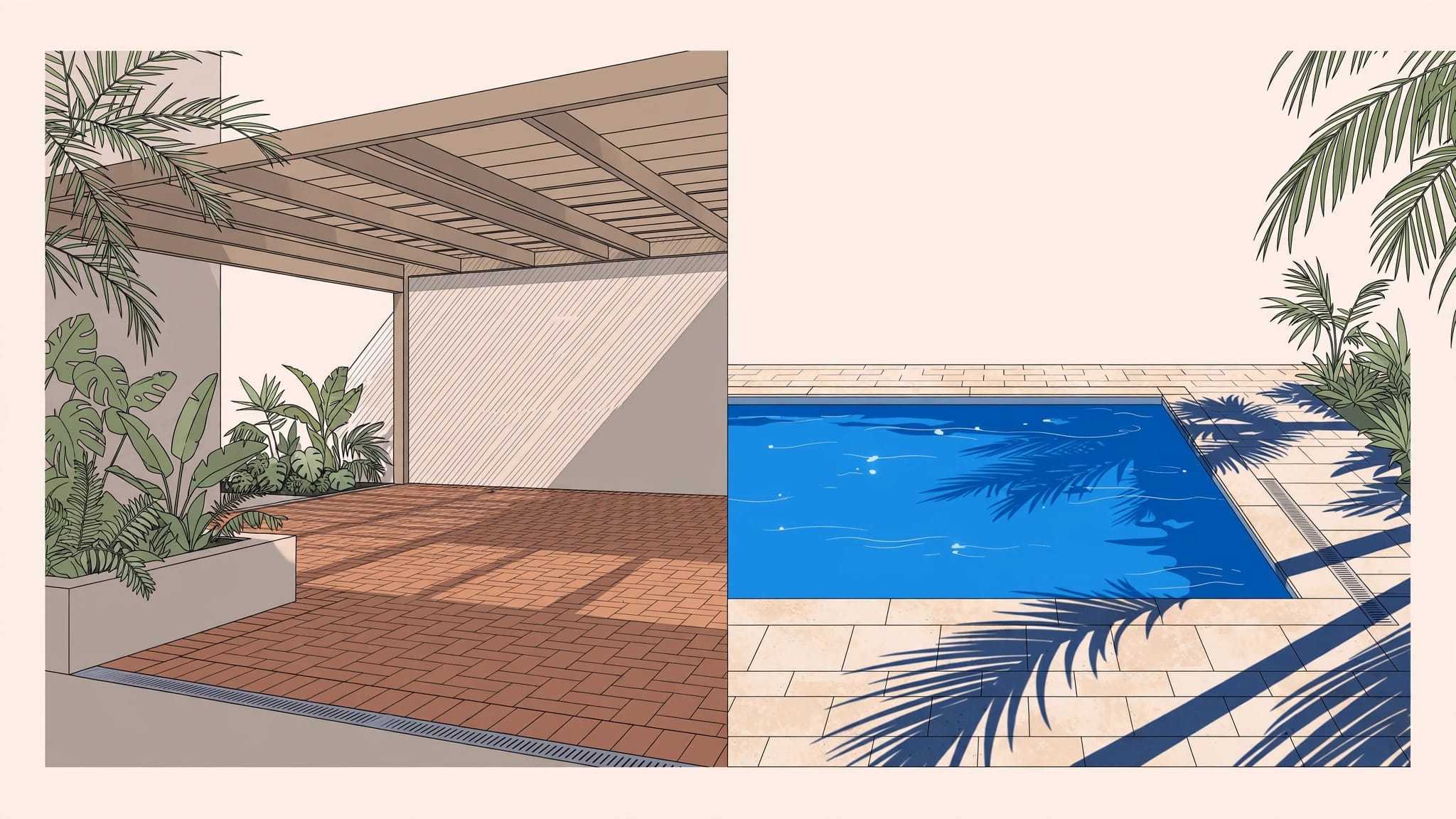
A Florida lanai is more than a place for weekend cookouts. As an outdoor living space, it faces sun, rain, pool water, humidity, palm debris, and bare feet. Choosing between brick and travertine affects comfort long after installation day.
I have seen both materials look excellent in Southwest Florida homes. I have also seen the wrong choice create hot walking surfaces, slip concerns, drainage issues, stubborn stains, fading, and unexpected maintenance. The right decision depends on durability, installation, cost, comfort, and appearance.
Key Takeaways
- Brick offers a durable, structured, and traditional appearance, making it a strong fit for shaded or covered lanais and homes with brick walkways or driveways.
- Travertine generally stays cooler underfoot in direct Florida sun, making it especially comfortable for poolside lanais and barefoot use.
- Wet traction depends on the finish, drainage, cleanliness, and sealer—not just the paver material. Tumbled travertine is typically a better poolside choice than polished or honed stone.
- Travertine usually costs more and needs regular sealing, while brick requires attention to joint sand, mildew, efflorescence, and shifting pavers.
- Proper base preparation, slope, drainage, edging, cleaning, and material-appropriate sealing are essential for either option in Florida’s coastal climate.
Brick vs Travertine Lanai: Start With How You Use It
Brick and travertine both work outdoors, but they perform differently in a lanai. Before choosing color or pattern, consider direct sun, a pool deck connection, and how often your family goes barefoot.
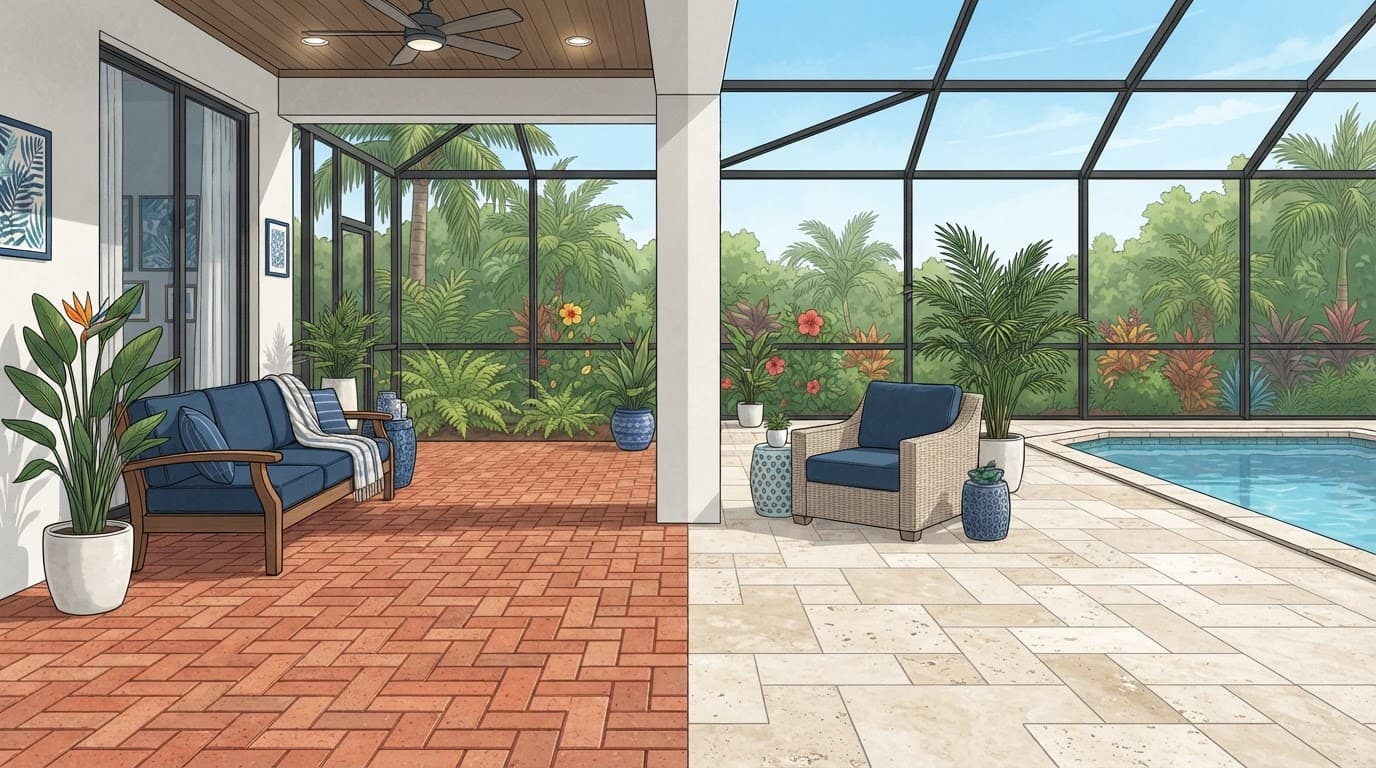
Brick fits traditional and shaded outdoor spaces
Clay brick has a classic, warm look. Brick pavers in rich reds, browns, and blended colors fit Mediterranean homes, older Florida neighborhoods, and shaded or covered lanais.
Brick is also a tough, durable outdoor material with good weather resistance. Hard-fired clay pavers are made to last for decades, and the Brick Industry Association describes clay pavers as hard-fired for long-term use. Individual brick pavers can often be replaced without rebuilding the full area.
I usually recommend brick when the lanai is screened, covered, and not used as a pool surround. It is also a practical choice when you want the same paver style across a walkway, patio, and driveway.
Travertine suits poolside comfort and a lighter look
Travertine is a natural stone with soft color movement. No two pieces look exactly alike. Travertine pavers work well with light stucco, coastal homes, modern pool cages, and outdoor kitchens.
The biggest advantage is comfort in the sun. Light-colored travertine generally stays cooler underfoot than darker brick. On a hot Fort Myers afternoon, that difference is easy to feel.
Finish selection matters more near water. Tumbled finishes offer more texture, while honed travertine has a flatter, cleaner look. A textured finish may offer more grip than honed travertine when wet, depending on the surface and sealer.
Travertine also has natural pores that help move water through the surface, but that does not make it maintenance-free. In most of Florida, rain, humidity, salt air, and pool exposure matter more than the freeze-thaw cycle.
Florida Heat, Rain, and Barefoot Comfort
Florida weather should carry more weight than a showroom sample. A paver can look perfect indoors and feel completely different at 2 p.m. in July.
Heat matters around pools
Brick absorbs and holds heat, especially in darker colors. In direct Florida sun, light travertine generally provides better heat resistance than dark brick. If your lanai gets full afternoon sun, brick can become uncomfortable for bare feet. Outdoor rugs and shade help, but they don’t change the paver itself.
Travertine has a reputation for staying cooler underfoot, which is why it remains popular for a Florida pool deck. Honed travertine creates a smoother surface, but color still matters. An ivory or shellstone blend usually offers better barefoot comfort than darker stone in direct sun.
I tell homeowners to stand in the actual space at different times of day. Notice where the sun lands and how the surface temperature changes. A covered lanai has different needs than an open patio beside a south-facing pool.
Wet traction depends on the finish and upkeep
Neither material should be judged by slip resistance alone, because neither is slip-proof when wet. Pool water, sunscreen, algae, and a glossy sealer can all change the walking surface.
For a lanai beside the pool, I prefer tumbled travertine over polished stone or honed travertine. Tumbled travertine adds texture and often improves wet grip. Honed travertine has a smoother surface, so it may need more care around water.
Brick’s textured face can also provide good footing, especially when it is clean and free of slick mildew. Honed travertine may feel smoother underfoot, particularly when sunscreen or algae builds up.
A paver’s finish, drainage, and sealer choice affect slip resistance as much as the material itself.
Keep the area clean, and make sure water drains away instead of sitting in low spots. Good drainage and prompt cleaning protect safety and the installation, especially with honed travertine.
Appearance and Paver Patterns
Your lanai floor should work with the home, not fight it. Brick creates a more defined pattern, while travertine offers quieter aesthetic appeal and a more natural look.
Brick brings color and structure
Standard brick pavers come in consistent sizes and install well in running bond, herringbone, basket weave, and stacked patterns. Herringbone is especially useful where traffic is heavier because the interlocking layout holds up well.
Brick has more visual contrast. That can look great around a rustic outdoor kitchen or a home with warm exterior colors. It can also make a small lanai feel busier if the space already has bold furniture, stucco, landscaping, and outdoor-kitchen finishes.
Choose a blended brick color rather than one solid shade. Florida sun will fade and weather every outdoor surface over time, and color variation helps the patio age more naturally.
Travertine creates a relaxed upscale finish
Many travertine pavers come in square and rectangular sets. The popular french pattern combines several sizes for a more custom appearance. It is a strong choice for larger lanais because it breaks up a wide open floor without looking crowded.
Natural stone’s pores and color changes are part of its character. A tumbled travertine finish softens the edges and adds texture for a casual poolside look. Cream, ivory, tan, and light walnut tones work well with pool water, palms, and coastal landscaping. This guide to travertine pavers explains how porosity and sealing affect natural color movement on a finished lanai.
Honed travertine offers a smoother, more uniform finish. Honed travertine can reflect more glare in direct Florida sun, while a stone paver still shows natural variation. Choose honed travertine for visual consistency, or accept that movement for the natural beauty of the stone.
What Brick and Travertine Cost in Florida
The material price is only one cost consideration. A fair estimate should separate demolition, base preparation, drainage, edging, labor, cuts, joint material, and planned sealing.
Published 2026 Florida estimates put many travertine projects in the mid-teens to upper-$20s per square foot installed. Brick can start lower for a simple patio, but premium clay brick, custom borders, and difficult layouts can approach travertine pricing.
| Cost factor | Brick pavers | Travertine pavers |
|---|---|---|
| Material price | Often lower for basic styles; premium clay brick can cost more | Usually higher for quality natural stone |
| Demolition | Existing surface removal adds to the scope | Existing surface removal adds to the scope |
| Base preparation | Similar cost when the soil and grade are sound | Similar cost, with careful leveling still essential |
| Drainage | Added slope or channels may increase the scope | Added slope or channels may increase the scope |
| Edging and restraint | Required to limit movement at the perimeter | Required to limit movement at the perimeter |
| Cuts and layout | Simple patterns can help control labor | Curves, pool deck edges, and drains can raise labor |
| Joint material | Sand or compatible joint fill | Joint fill suited to natural stone |
| Labor | Straightforward patterns may reduce labor | Detailed cuts and layouts may increase labor |
| Sealing | Helpful, but often less frequent | Regular sealing is part of ownership |
Basic concrete pavers may provide a lower material benchmark, but the lowest quote isn’t always the best value. A weak base, poor slope, inadequate drainage, or rushed edge restraint can cause movement with either material. Fixing settlement later costs more than installing it correctly the first time.
For a fair comparison, I recommend requesting estimates for the same square footage, pattern, base preparation, drainage plan, edging, joint material, labor, and sealer. Ask for the installation cost to be listed separately from materials and site work. Otherwise, you’re comparing two different jobs.
Maintenance Is Where the Materials Separate
Both surfaces need regular paver maintenance in Southwest Florida. Pollen, leaf tannins, algae, pool chemicals, fertilizer, and salt air do not leave pavers alone for long.
Travertine needs gentle cleaning and regular protection
Travertine is porous natural stone. Sealing helps limit stains from leaves, spills, oils, and pool chemicals. Honed travertine may show absorbed spills and residue more clearly than tumbled travertine.
One current Florida maintenance guide recommends resealing travertine about every two to three years. The right schedule depends on sun, traffic, and the sealer used. If you seal travertine, choose a compatible penetrating sealer and follow the product’s maintenance schedule.
I don’t recommend harsh acidic cleaners on natural stone. Muriatic acid can etch the surface and leave it rough or blotchy. On honed travertine, that damage may be more visible because of its smoother face. The Natural Stone Institute’s care guidance recommends neutral cleaners or mild dish soap and warm water for stone surfaces.
Watch for fading sealer, dark absorbed spots, white mineral buildup, or areas that stay damp. On honed travertine, sealer changes may look different from those on tumbled travertine. Those are signs the lanai needs attention.
Brick needs clean joints and stable sand
Brick pavers can tolerate regular cleaning well, but the joint sand is important. It supports the pavers and helps limit shifting. Heavy rain, pool splash-out, and aggressive cleaning can wash it away.
When I inspect brick, I look for empty joints, loose pavers, white haze, dark mildew, and uneven color. White haze is often efflorescence, which is mineral salt left behind as moisture dries. It should be diagnosed before treatment because the source may be drainage, irrigation, or moisture coming through the base.
A sealer made for driveways isn’t automatically right for a brick or travertine lanai. I wouldn’t use it without confirming that it suits the material and moisture conditions. The sealer should also match the desired finish. A wet-look sealer may deepen color, but it can make a poolside surface look too glossy.
Cleaning a Florida Lanai Without Damaging It
A clean lanai is safer, looks better, and makes paver problems easier to spot. A pressure wash can help, but it requires controlled pressure. More force is not always better.
Controlled pressure washing protects pavers and joints
Pressure washing can remove dirt, mildew, and loose residue from brick pavers. It can also cut lines into the surface, strip old sealer, and remove joint sand when the wrong nozzle or pressure is used.
The safest approach is controlled. Use a wide spray pattern, pre-treat buildup when needed, clean flat areas with a surface cleaner, and finish with a careful rinse. The goal is to lift residue without blasting the pavers apart.
Honed travertine needs even more care. High pressure can open the pores, etch the face, and leave a patchy appearance on honed travertine. Test a small area first, especially if the surface has been sealed before.
Use soft washing where force is not the answer
A soft wash is useful for light organic growth on delicate surrounding surfaces, including some stucco, screens, and lanai walls. It isn’t a replacement for a paver-safe cleaning process when the issue is embedded dirt, mineral deposits, or failing sealer.
Roof runoff also deserves attention. Chemicals, algae, and dirty water can land on a lanai floor and leave staining behind. Natural stone can react poorly to products that aren’t made for it.
After cleaning, let the pavers dry fully. Clean surfaces and removed algae can improve slip resistance, while intact joints support safer wet footing. Then inspect the joints, check drainage, and assess sealer condition before deciding whether re-sanding or sealing is needed.
Choosing the Material That Fits Your Home
Choose brick if your lanai is mostly shaded, you prefer a traditional pattern, and you want durable continuity with a brick driveway or walkway. It works well when barefoot heat is not your main concern.
Choose travertine if the lanai gets strong sun, connects to a pool deck, or needs a lighter, high-end appearance. Its cooler surface can make barefoot use more comfortable, though it often costs more and requires careful sealing.
Consider how you use the outdoor living space, then plan for sound installation, proper drainage, periodic cleaning, and material-appropriate sealing. In Florida’s coastal climate, salt air, humidity, sun, and rain make consistent maintenance important for either material.
Frequently Asked Questions
Is brick or travertine better for a Florida poolside lanai?
Travertine is often the better choice for a sunny poolside lanai because light-colored stone generally stays cooler underfoot than darker brick. Choose a textured or tumbled finish and maintain good drainage for safer wet footing.
Does brick get hotter than travertine in Florida?
Brick can absorb and hold more heat, especially in dark colors and direct afternoon sun. Light-colored travertine usually provides better barefoot comfort, although shade and surface color affect both materials.
Is travertine more expensive than brick pavers?
Travertine typically has a higher material cost, while basic brick can provide a lower starting price. Custom brick patterns, premium clay pavers, difficult cuts, drainage work, and detailed layouts can bring the installed prices closer together.
Which material requires more maintenance?
Travertine generally needs more specialized maintenance, including compatible sealing and gentle, non-acidic cleaning. Brick also needs regular cleaning, stable joint sand, and inspection for mildew, efflorescence, and shifting pavers.
Final Thoughts
The best brick vs travertine lanai choice depends on your sun exposure, pool use, style, and budget. Brick offers a structured look, lasting durability, and potentially lower initial cost. Travertine provides a cooler surface, natural variation, and comfortable poolside use when properly finished and maintained.
Proper installation protects either material. Maintain good drainage and stable joints, prevent stains, expect some fading, and use the correct sealer to protect your investment.