
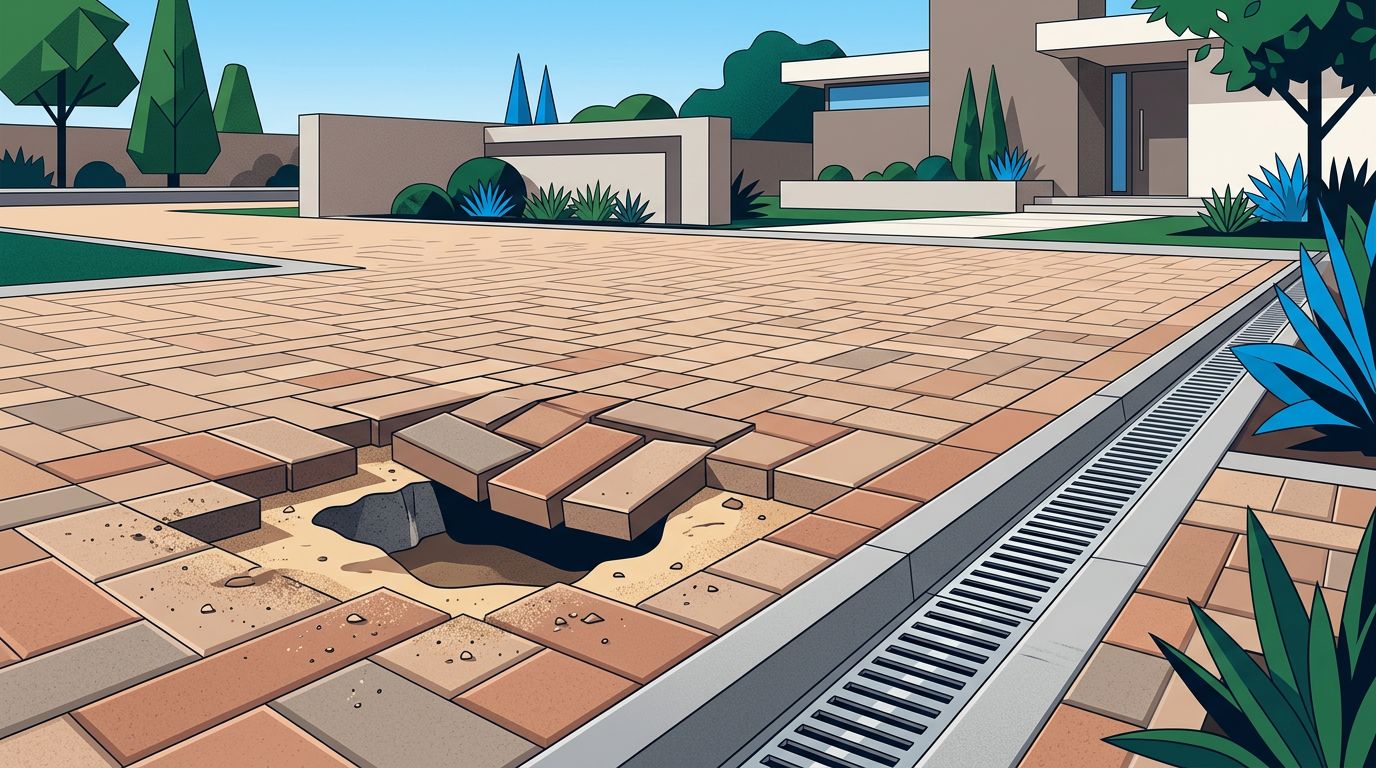
A driveway can look level from the street and still have missing support beneath the pavers. A small dip that grows after rain is one of the clearest reasons to take a closer look.
When I check for paver driveway voids, I look at the joints, edges, and path of the water before recommending a repair. A loose brick may need a simple reset. Several moving together can point to a problem deeper in the base. Here’s how you can spot the difference without putting weight on an unsafe area.
Why paver driveway voids develop
Pavers rely on the layers beneath them. The units sit on bedding material, which rests on a prepared, compacted base. Joint sand and edge restraints help hold the finished surface in place. If support washes away or settles, the pavers above it may tip, rock, or sink.
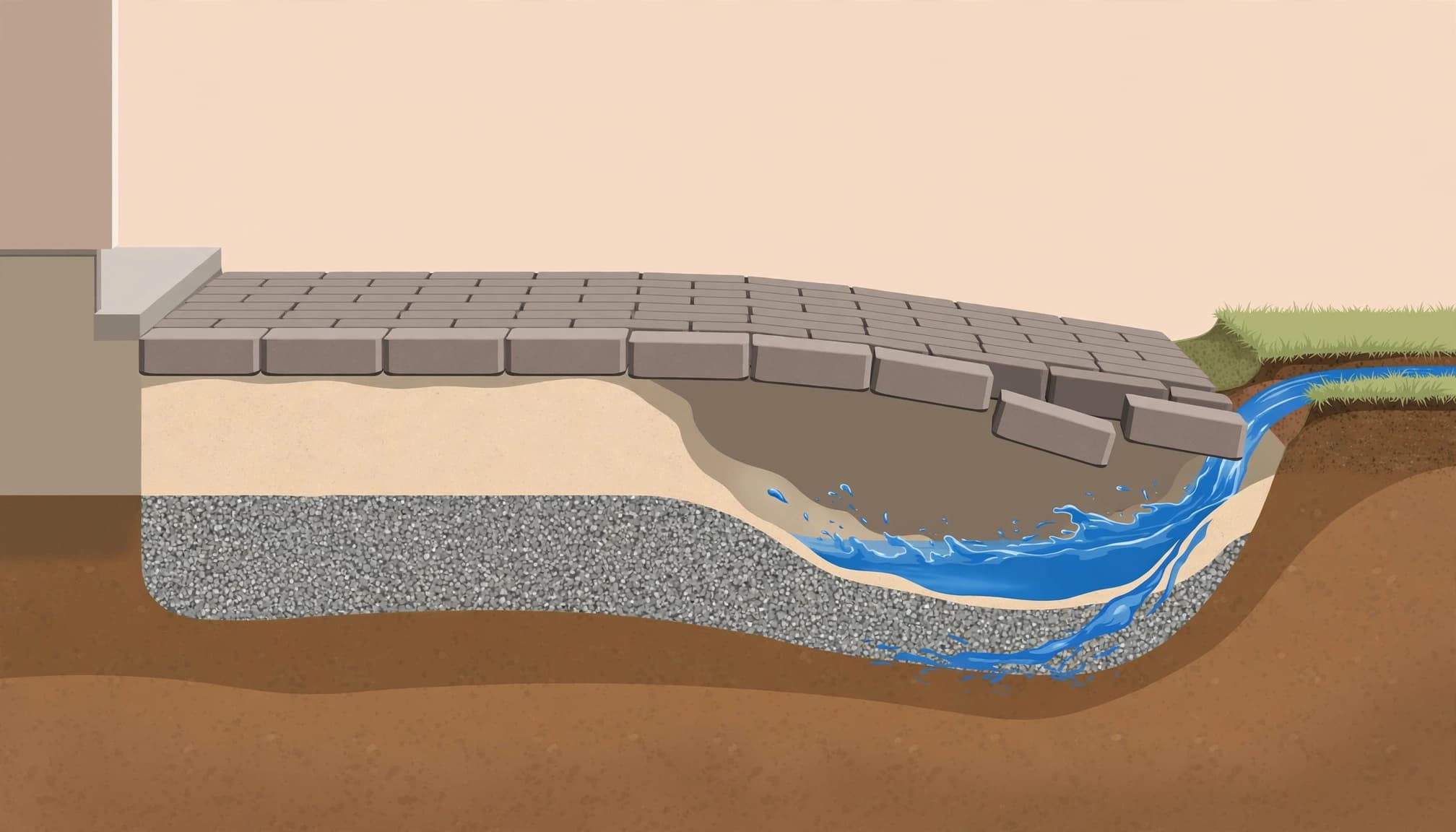
Water carries away support
I pay close attention to downspouts, low borders, and drains that collect sand after storms. Repeated runoff across one area can cause soil erosion, removing joint material and disturbing the bedding or base. The CMHA application guide for interlocking pavements addresses drainage through the pavement system, not only across its visible surface.
Missing joint sand alone doesn’t prove there’s a cavity. When it appears beside a growing dip or washed-out edge, though, I want to know where that material went.
Settlement and edges change the pattern
Poor subgrade compaction can lead to settling soil beneath vehicle traffic, causing a section to sink. A loose edge restraint can also let the outer row spread, opening joints across nearby pavers. Animal activity or decaying roots may disturb the soil in some locations. Those possibilities call for an inspection, not a guess based on one loose brick.
The pattern matters most. One rocking unit can point to a local bedding problem. Several pavers moving together call for a closer look at the base, border, and drainage.
Inspect the driveway without making a weak area worse
Start with what you can see from stable ground. If an area has dropped sharply or an edge appears undermined, keep people and vehicles off it to reduce fall and tripping hazards. Don’t test it by driving over it or jumping on the pavers.
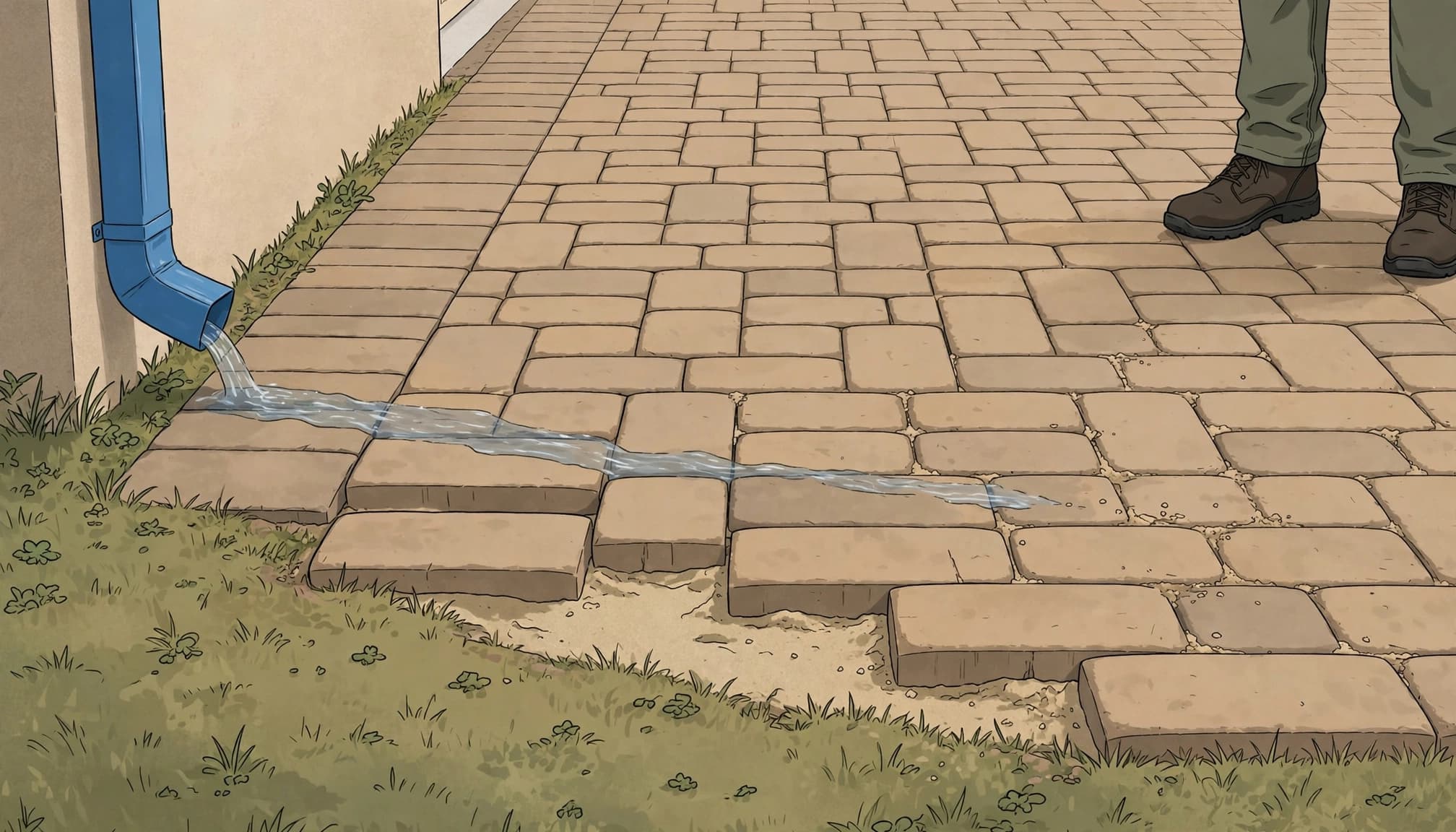
Look for movement and missing material
Walk the driveway carefully and compare nearby rows. I look for widening joints, uneven paver tops, a border pulling outward, and sand collecting at a drain or the bottom of a slope. At a safe edge, you may be able to see missing material beneath a paver without lifting anything.
Check the same area again after heavy rain. Note where puddles remain and whether the dip looks larger. Photos taken from the same position make changes easier to track. My paver maintenance checklist also covers empty joints and what to check after storms or cleaning.
These checks are homeowner observations, not a substitute for a professional assessment. A professional may use ground penetrating radar as one tool, but it doesn’t confirm a void by itself.
Separate surface wear from lost support
A stain, worn sealer, or chipped paver face can look bad while the surface stays firm. A paver that rocks under normal foot traffic deserves a different response. If three or four neighboring units move together, I would check below the bedding rather than treat each brick as a separate repair.
Look closely at garage entrances and outer rows. Tires put pressure on those areas, especially when you turn. A spreading edge can leave the interior pavers less secure even before a large low spot appears.
Follow the water before choosing a repair
A repair won’t hold for long if runoff keeps removing material from the same place. Check gutters, downspouts, irrigation heads, nearby slopes, and the route water takes during a storm to spot drainage issues. If water stands beside the garage or foundation, address that drainage concern promptly.
I also look at the surrounding grade. Soil piled against a driveway edge can redirect water onto the pavers. A drain outlet that empties beside the base may leave the border wet even when the surface looks clear. Where runoff needs a better route, paver drainage channels are one option to assess.
Exterior cleaning can affect what you find. After pressure washing, check whether joint sand has been displaced. If roof cleaning with a soft wash is planned, watch where roof runoff and rinse water travel around the driveway. Follow the cleaner’s directions for handling that water. Cleaning can reveal a low spot, but it won’t correct the grade beneath it.
If sand keeps disappearing from the same edge, I look for the water route before adding more sand.
Confirm what is happening below the pavers
Surface clues tell you where to investigate. They don’t tell you the size or depth of a hidden gap. The next step depends on how much has moved and what is nearby.
Lift a limited area when it is safe to do so
For a small, accessible repair, lifting affected pavers lets a contractor inspect the bedding and base directly. I want to know whether the material is dry and firm, wet and soft, or missing altogether. That answer matters more than how the pavers look after someone adds fresh sand.
If movement extends across a broad area, excavation may need to cover more than the lowest spot. Utility lines, retaining walls, a garage entrance, or a nearby foundation also change how the work should be planned. Don’t dig into an unknown area without checking for buried utilities.
Ask what professional testing can establish
Ground penetrating radar (GPR) is one type of non-destructive testing a qualified operator may use to investigate subsurface conditions without opening the entire driveway. Pavement research on GPR describes non-contact estimates of density and moisture, which can inform an assessment of pavement condition and structural integrity. Research involving concrete voids doesn’t automatically prove a gap exists beneath residential pavers.
Impulse-response and ultrasonic pulse-echo methods are also used in pavement or concrete testing. Their suitability depends on the surface, including whether it’s pavers or concrete slabs, and the question being asked. If a contractor proposes ground penetrating radar, ask what it can establish in your driveway and how the findings will be checked before repairs begin.
Choose a repair that fits a paver driveway
Many methods advertised for driveway gaps, including products for concrete voids, are designed for poured concrete slabs. Pavers come apart and can be reset. That gives a contractor direct access to failed support, unlike a solid slab.
Rebuild weak support before resetting pavers
When the bedding has shifted but the base remains firm, the repair may be limited to the affected units and bedding layer. Soft, muddy, or missing base material calls for more work. Assess the base and drainage before resetting pavers to protect the driveway’s structural integrity.
I’d remove unstable material, rebuild and compact the base in layers, then set the bedding and pavers to the proper grade. A failed edge restraint needs attention before the outer row goes back. Once the pavers sit firmly, fill the joints with compatible material. Polymeric sand may help stabilize suitable joints when installed according to its product directions. It can’t carry a vehicle over a weak base.
Keep slab-lifting methods in their lane
Mudjacking pumps a grout-based mixture beneath concrete slabs. Polyurethane foam injection is used for concrete leveling, including lifting sinking concrete. Missouri DOT’s slab-stabilization guidance identifies both methods in a concrete repair setting. Their use for concrete voids doesn’t automatically transfer to pavers, since these methods address concrete slabs.
I wouldn’t attempt void filling or inject a DIY expansion foam kit into a suspected cavity without knowing its size, depth, and exit path. Added water may carry more material away, while foam-based void filling can conceal the base’s condition without fixing the runoff that caused the trouble. If the driveway includes an adjoining poured-concrete section, have it assessed separately. Concrete replacement is a distinct consideration for that pavement; FHWA’s concrete pavement preservation guide covers a different pavement structure.
Finish the repair in the right order
Once the base and drainage are corrected, the surface work can begin. I check that reset pavers feel solid, neighboring rows line up, and water moves away from the problem area. Fresh joint material goes into clean joints only after the structural work is done.
Driveway sealing belongs near the end of that process. It can help maintain a properly prepared surface, but it won’t fill a cavity or lift a sunken paver. Cleaning and sealing over an unstable area can leave the same movement hidden beneath a better-looking finish. For more on that order of work, see brick paver repair, cleaning, and sealing.
Permeable pavers need extra care. Their joints are part of the drainage system, so ordinary joint sand or a standard coating may interfere with how the installation works. Check the system requirements before replacing material or sealing; the Interpave permeable pavement guide covers design and maintenance considerations for these systems.
If your pavers are stable and you’re planning cleaning or sealing, Get a Quote for pressure cleaning or sealing services. If they’re moving, explain that first so the support and drainage can be assessed before surface work is scheduled.
Key Takeaways
- A single loose paver may need a local repair; a cluster that moves together deserves a base and drainage inspection.
- Empty joints, recurring puddles, and sand collecting at a drain are useful clues, not proof of a hidden cavity.
- Stable repairs address missing support and the water route before pavers are reset and joints are filled.
- Foam injection and mudjacking are concrete slab methods. Don’t assume they’re the right fix for a modular paver driveway.
Frequently Asked Questions
Can sand and water fill a void under driveway pavers?
I don’t recommend washing sand into a suspected cavity. You can’t see whether it reaches the missing area or stays in place. Extra water may worsen an existing washout. If the base is firm and only the bedding needs adjustment, lift the affected pavers and repair that layer directly.
When should a homeowner stop using the driveway?
Keep vehicles off a sharply sunken section, an undermined edge, or an area where several pavers move underfoot. A sudden drop or unstable area could signal a sinkhole issue, but surface clues alone can’t diagnose one. Keep people away and arrange an inspection before putting weight back on the area. Repair even a small loose paver before traffic spreads the movement.
Can a void beside the house affect the foundation?
A low paver area alone doesn’t prove property damage or mean foundation repair is needed. Water flowing toward a foundation wall or garage, however, needs attention beyond resetting pavers. I’d ask a qualified contractor to assess the drainage and any signs of movement in the adjoining structure.
Do animal burrows always mean the base has failed?
No. A burrow near an edge is a reason to inspect the soil and restraint, not proof that the driveway has a large cavity. Look for loose material, repeated settlement, and nearby water entry. Repair damaged support and address the animal activity before closing the area.
Keep the driveway supported
That first small dip is easier to deal with when you can still see where water goes and which pavers have moved. I start with the pattern on the surface, then check the material underneath before choosing a repair.
Find the cause before covering the gap. A firm base, secure edges, and working drainage do more for your driveway than a surface patch over missing support.