
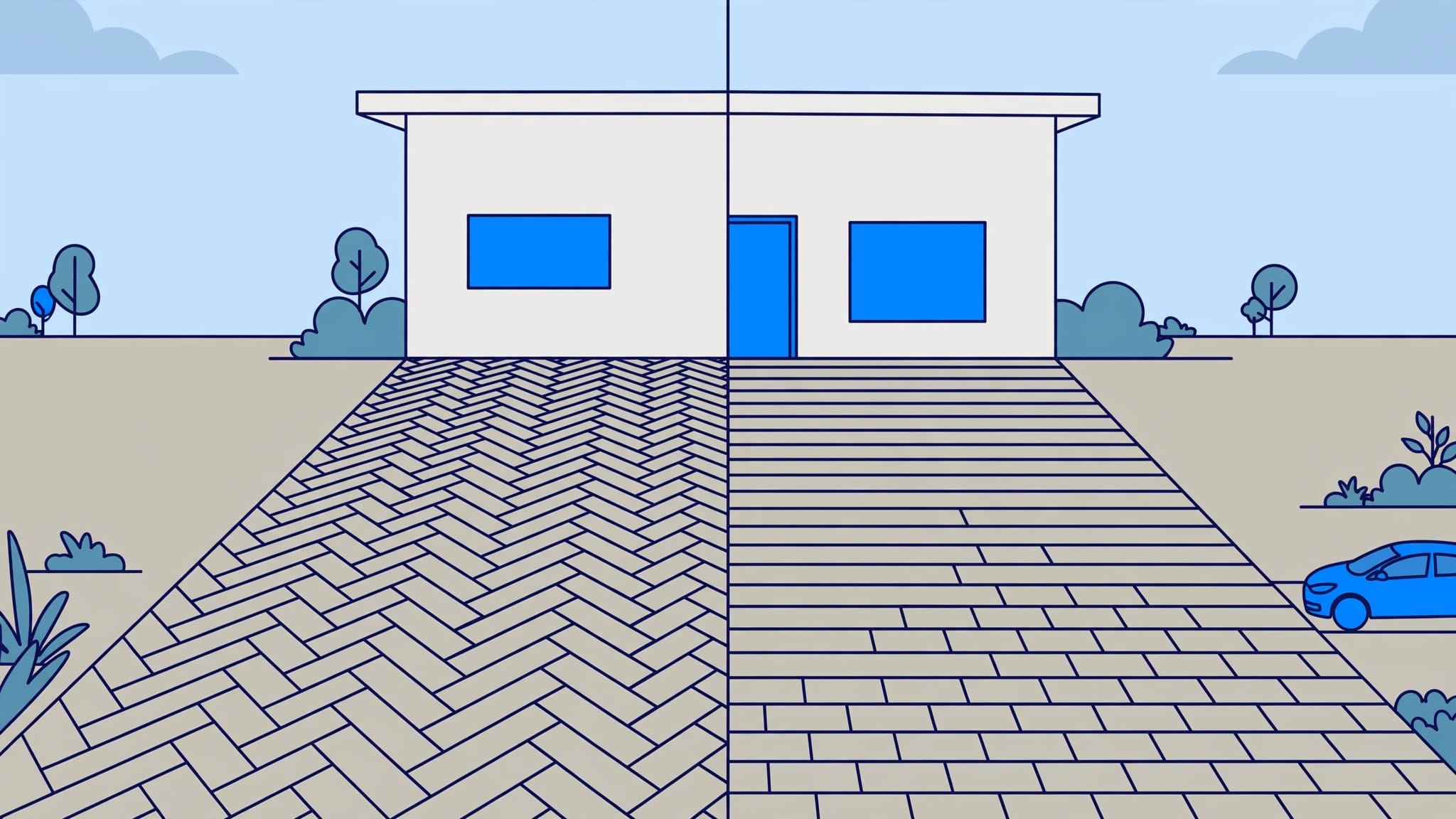
I recommend herringbone for most driveways, especially where vehicles turn, brake, or park regularly. Running bond can work for residential traffic, but its orientation and the driveway’s shape need more attention.
When comparing driveway paver patterns, appearance is only part of the decision. Your pavers also need dependable support, secure borders, and properly filled joints. Start with how each pattern handles vehicle movement, then consider edge work, material requirements, and maintenance.
Key Takeaways
- Herringbone has the strongest bond among these common layouts and is my first choice for heavy traffic.
- Running bond is more stable across the driveway than lengthwise, according to Western Interlock.
- Simpler layouts can require less edge work, but they don’t resist vehicle movement as well.
- A suitable base, vehicle-rated pavers, and secure edges matter with every pattern.
Herringbone provides the strongest driveway interlock
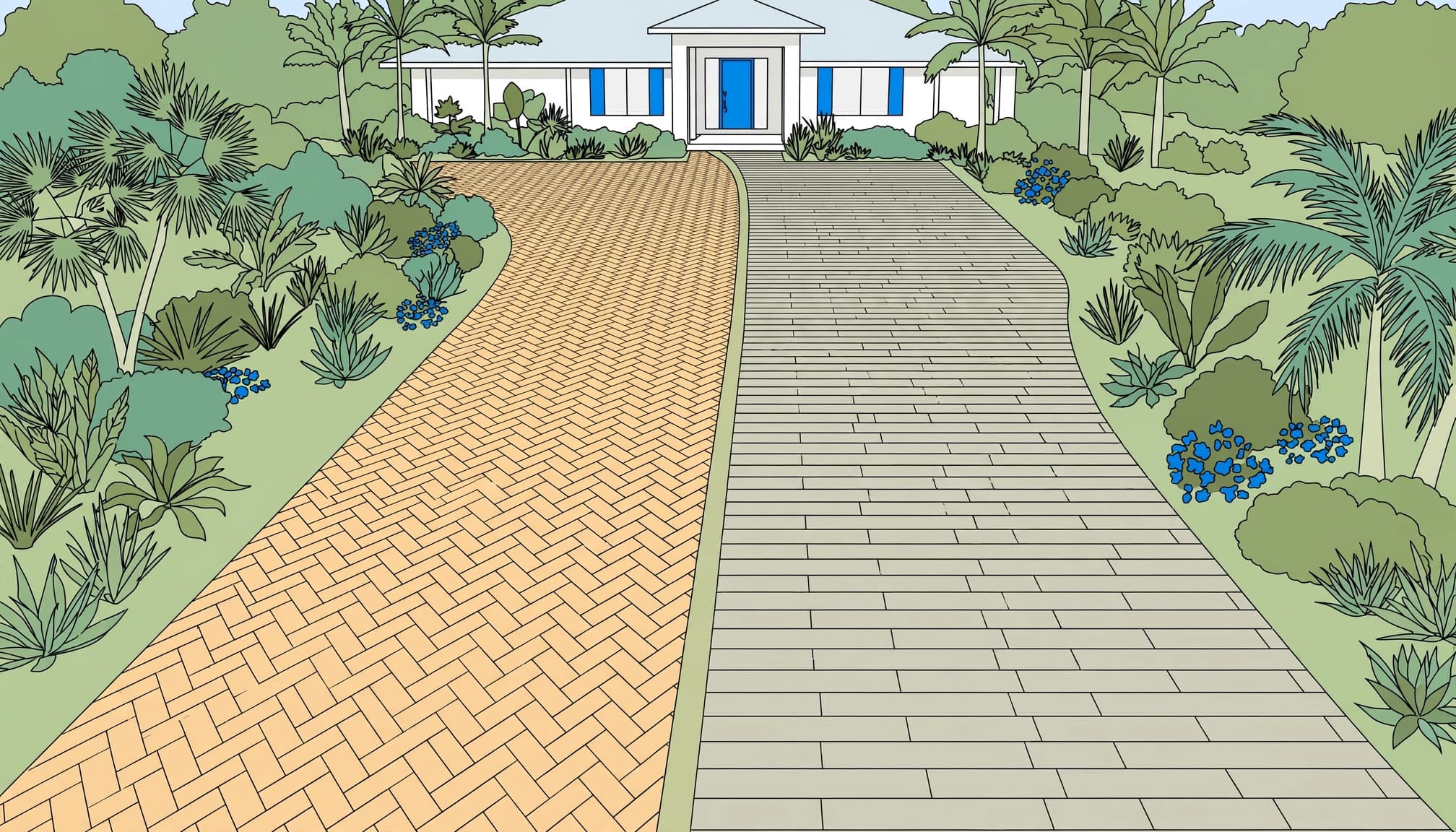
Short bond lines resist vehicle movement
Herringbone places rectangular paving stones at right angles in a repeating zigzag. It has the shortest bond lines among these common patterns, which helps the paving resist movement in different directions.
Those short joints provide superior interlock under turning tires and braking vehicles. That’s why herringbone is such a popular choice for driveways and parking lots.
The Concrete Masonry & Hardscapes Association recommends herringbone for street applications in its concrete pavement guidance. For a homeowner, that supports choosing it where traffic places repeated demands on the surface.
Both 45-degree and 90-degree layouts work
You can lay herringbone at 45 or 90 degrees to the driveway’s main reference line. Both arrangements provide interlock. The difference affects appearance, layout, and perimeter cuts.
I favor choosing the angle around the driveway’s shape and border rather than treating 45 degrees as automatically stronger. A diagonal layout creates a more noticeable pattern, while 90 degrees looks more aligned with the house.
Double herringbone groups pairs of pavers together for a larger repeating design. It’s another appearance option, not a reason to reduce the supporting construction.
Running bond needs careful orientation
Lay staggered rows across the driveway
Running bond uses rows offset by half a stone, much like a traditional brick wall. The layout is familiar, orderly, and easy to follow during installation.
Western Interlock recommends laying running bond width-wise across a driveway, rather than lengthwise, for better stability against vehicle movement. That orientation matters because the pattern still contains long, continuous joints.
Its paver pattern video takes a more cautious position. The linked video discourages running bond for heavy vehicular traffic and areas with multiple slopes. It also favors the appearance of 45-degree herringbone.
My recommendation is straightforward: consider running bond for a simple residential driveway, but choose herringbone when turning, heavy loads, or changing slopes are major concerns.
Matching half-size units can reduce cuts
Running bond generally needs half units at alternating row ends. A factory-made Half Holland paired with Holland Stone can eliminate those particular end pieces.
Western Interlock identifies Half Hollands with Holland Stone, Camino Squares with Camino Recs, and Parks with Plazas as compatible pairings. Check the paver sizes listed for each product before assuming the units are compatible.
Camino Stone is a separate product family, so check the manufacturer’s specifications before substituting its units for Camino Squares or Camino Recs.
That doesn’t eliminate every cut on the project. Curves, angled boundaries, drains, and the garage transition can still require cutting. I’d compare the complete layout before assuming running bond means a cut-free installation.
Stack bond is easy to align
Stack bond uses one stone size with corners lined up in straight rows. Its clean grid can suit a modern or contemporary exterior, and DIY installers can keep it straight and square relatively easily. A well-matched rectangular area needs minimal edge work.
The drawback is its uninterrupted joints in both directions. They provide less resistance to movement than herringbone’s bonding arrangement.
I wouldn’t make ordinary stack bond my first choice for a driveway carrying repeated vehicle traffic. Its simple appearance doesn’t replace the need for a paving system designed for that use.
Basketweave creates a traditional appearance
Basketweave places pairs of rectangular paving stones in alternating directions at right angles. For the standard arrangement, each stone’s width must be half its length.
A square boundary can keep perimeter trimming relatively simple. Rotating the pattern or using curved borders adds more edge work.
Basketweave provides less interlock against heavy traffic than herringbone. I would choose it for its traditional appearance only within an appropriate vehicle-rated system, rather than assume any basketweave installation suits a driveway.
Random and modular patterns need a planned layout
Many paver families include several sizes that fit together as modules. The manufacturer’s paver pattern guide shows compatible arrangements, which helps avoid oversized gaps and awkward cuts.
Random patterns still follow structural rules
A random pattern should be planned as a system, not improvised one stone at a time. Keep four corners from meeting at one point, and don’t let a joint continue straight for more than about four feet.
Those rules break up long joints and help the surface work together. They don’t establish a vehicle rating by themselves. I’d use a manufacturer’s driveway-approved combination and lay out the sequence before installation.
Multi-size patterns require the right proportions
The guide gives these approximate blends.
| Pattern | Approximate material blend | Important detail |
|---|---|---|
| Muster K, also called the I Pattern | 73% rectangles, 27% squares | The manufacturer describes it as its best-selling pattern. |
| 3 Stone I | 37% large rectangles, 27% squares, 36% small rectangles | This arrangement uses Camino Stone only and needs perimeter cuts. |
| Five Stone | 43% Arena, 32% Park, 16% Plaza, 8% Holland Stone, 4% Half Holland | Five sizes must be coordinated throughout the layout. |
These are approximate pattern references, not finished purchase quantities. The installer is responsible for calculating the correct material order, including borders, cuts, breakage, package quantities, and Half Holland units.
For the 3 Stone I order, confirm the Camino Stone module specifications before estimating quantities. The named pattern and product must both be suitable for driveway use. A decorative multi-size blend doesn’t automatically provide the same performance as vehicle-rated herringbone.
Driveway shape affects cutting and cost

A straight driveway gives you more flexibility than a curved entrance or a surface with several grade changes. Tight turns and repeated steering movements favor herringbone’s resistance to movement in multiple directions.
A diagonal herringbone layout usually needs more edge cutting than straight running bond. Curves increase cutting regardless of the pattern inside the border.
For material planning, around 10% extra is a common allowance for straightforward layouts. Cutting-heavy herringbone, diagonal, or curved designs can need 15% to 20%. Those allowances address waste and breakage, not additional finished driveway area.
I recommend comparing quotes with the same scope: excavation, aggregate, drainage, pavers, edging, cutting, and finishing. A lower paver price doesn’t tell you which complete installation offers better value.
CMHA’s homeowner pavement planning guide includes agreeing on the pattern and anticipated edge cuts before laying starts. That helps keep the finished border consistent with the design.
Driveway paver patterns need a dependable base
Match thickness and support to the vehicles
For ordinary residential traffic, vehicle-rated 60 mm pavers are a common starting point. RVs, heavy trucks, and frequent heavy loading generally call for 80 mm products and stronger support.
Thickness alone doesn’t establish suitability. Paver dimensions, soil, drainage, and the complete installation also affect performance. My driveway paver thickness guide explains that distinction.
For conventional aggregate construction, a typical compacted base ranges from 6 to 12 inches, depending on conditions and traffic. Approximately 1 inch of bedding sand goes above it. These are conditional planning figures, not one specification for every property.
In Southwest Florida, heavy rainfall and disturbed soil deserve close attention. Bedding sand can’t replace missing aggregate or repair soft ground.
Secure the perimeter and fill the joints
Edge restraints keep the field of pavers from spreading outward. Joint material helps neighboring units work together. Both are necessary even when the pattern has a strong pattern bond.
Conventional paver joints commonly measure about 1/8 inch, within a typical range of 1/16 to 3/16 inch. The correct spacing follows the paver profile and approved system.
Herringbone can resist vehicle movement, but it can’t compensate for a failed base or an unsupported border.
Prepare and compact the supporting layers properly before you install the pavers, then seat them with suitable equipment. Don’t use a thicker bedding layer to hide uneven base preparation.
Protect the finished driveway without hiding problems
Over time, watch for rocking stones, widening joints, missing sand, and recurring puddles. These conditions deserve attention before a protective coating is applied.
I recommend repairing movement first. Driveway sealing can help protect a compatible surface and simplify cleaning, but it won’t level settled pavers or secure loose edges.
Controlled pressure washing can remove buildup. Excessive force can damage the face or strip joint material, so the cleaning method needs to suit the pavers and their condition.
My Southwest Florida paver maintenance guide covers routine care. Keeping joints filled and drainage working helps protect whichever pattern you choose.
Frequently Asked Questions
Should driveway joints be wider than patio joints?
A driveway doesn’t automatically need wider gaps. Both can use conventional joints around 1/8 inch when the paver system allows it. The driveway needs a vehicle-rated assembly, while a patio may only need pedestrian support. Match jointing sand to the actual opening and required depth.
Can permeable pavers use the same joint filler?
Permeable paving uses a different drainage assembly and typically fills its openings with specified drainage stone rather than polymeric sand. Don’t apply conventional joint-filling advice to a permeable driveway. The layout, openings, filler, and underlying layers need to work as one system.
Choose Herringbone for Demanding Driveway Traffic
For heavy vehicles, frequent turning, or a more demanding driveway layout, I recommend herringbone. Running bond remains an option for simpler residential use when it runs across the driveway and the complete system suits vehicle traffic.
Whichever pattern you choose, dependable support and maintained joints protect the finished surface. For professional cleaning or sealing of a stable driveway, Get a Quote from Kingsway Paver Sealing.