
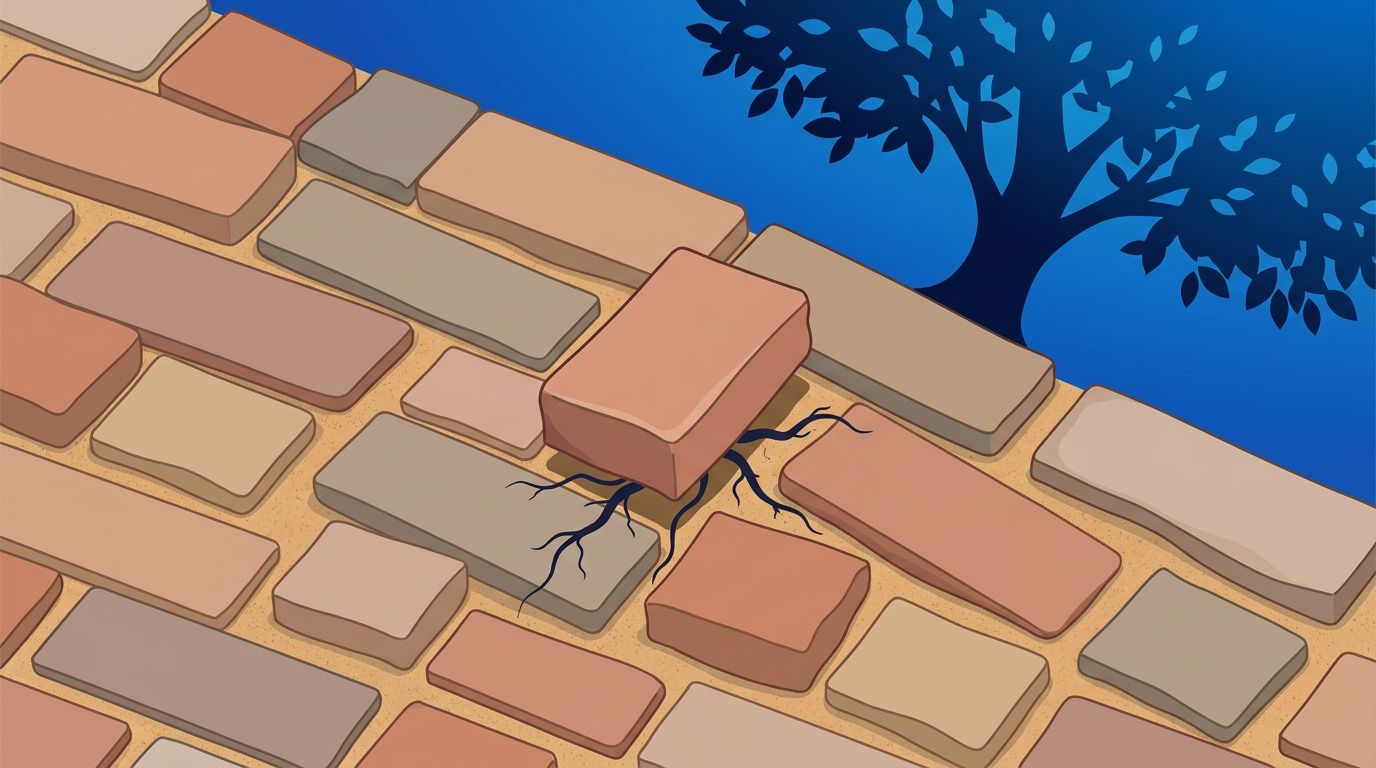
A brick walkway rarely fails all at once. It starts with one corner that feels a little high, one joint that keeps opening, one brick that rocks when I step on it. Then the pattern spreads, and the walkway stops looking like a flat path and starts looking like a warning.
That kind of damage usually gets blamed on age alone. Age matters, but tree roots and brick walkways have a much more interesting fight going on under the surface. Roots grow, soil shifts, water moves, and the bricks pay for all of it.
Why roots push brick pavers out of place
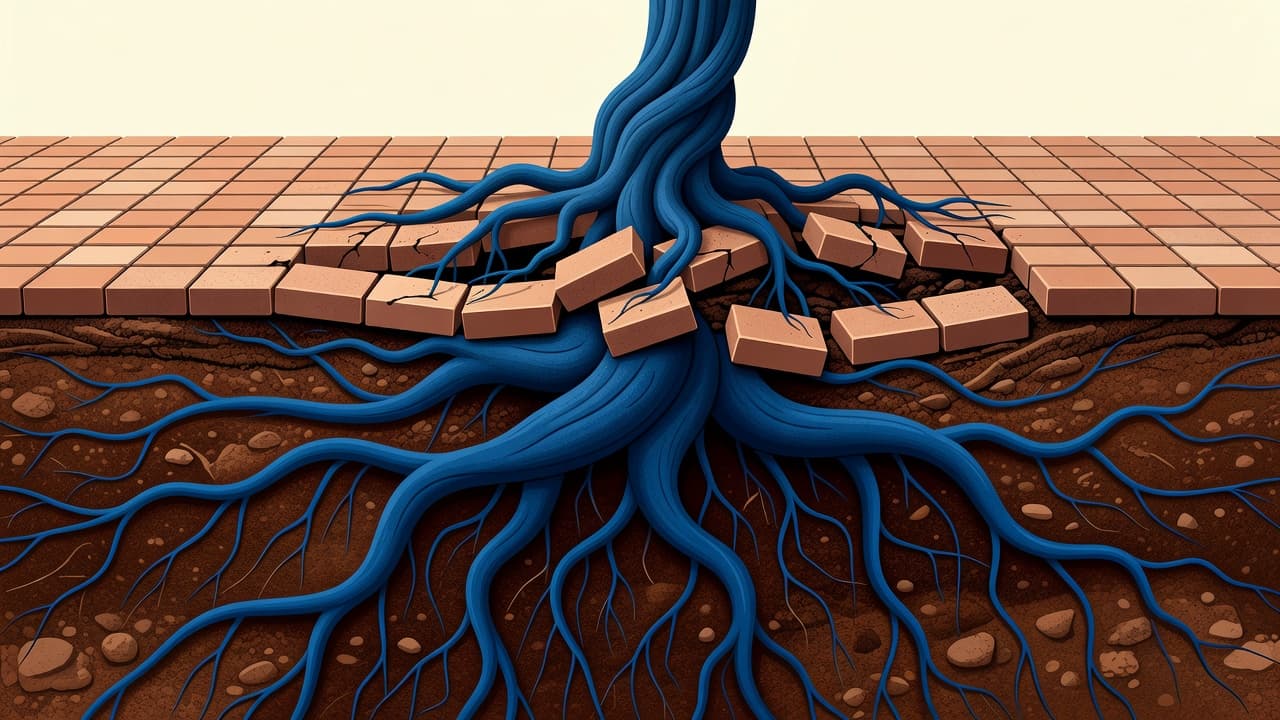
I think people picture roots as hard spears bursting upward through the ground. That’s not really how it works. Most of the time, roots spread sideways near the surface, looking for moisture, air, and space. A brick walkway gives them all three.
Brick pavers also sit on a layered system, not solid stone. There’s the bedding sand, the compacted base, and the joints between each brick. Once a tree root finds a weak point, it keeps widening that gap as it grows. The bricks above it don’t know why they’re moving. They just start riding on top of a shape that no longer stays still.
Moisture makes the whole thing worse. Roots pull water from the soil, then rainy seasons or heavy irrigation put it right back in. That cycle causes the ground to swell, dry out, settle, and swell again. Over time, the walkway starts to wave instead of sit flat.
I’ve seen homeowners think the brick itself failed. Usually, it’s the base that changed first.
For a simple visual on how roots and pavers end up working against each other, I like the breakdown in Unilock’s guide to tree roots and pavers.
The first signs I look for
Root damage usually gives itself away before the walkway becomes unsafe. The trick is knowing what to notice.
I look for a few things right away:
- A brick that rocks underfoot because the base under it is no longer even.
- Open joints near the edge where roots are pulling the layout apart.
- One side of the path that rises higher than the rest.
- Cracks in nearby mortar or edging that show the movement is spreading.
- Repeated weeds in the same gap because the opening keeps coming back.
A small bump can seem harmless. Then someone catches a toe on it. That is when a walkway becomes more than a cosmetic issue.
If one brick has started moving, I treat the rest of that section like it’s already involved.
I also pay attention to where the tree sits. A walkway beside a big shade tree is one thing. A walkway squeezed between a tree and a driveway is another. Roots don’t care about our clean little lines. They follow the easier path.
The same kind of pressure shows up on other hard surfaces too. I see it near patios, garden borders, and even poolside paths. Once the soil starts to change, the whole edge line can go with it.
What speeds up the damage
Not every walkway with nearby trees has trouble. Some hold up for years. The difference usually comes down to a few plain factors.
Tree size and age matter. Larger trees have larger root systems, and older roots keep thickening. A young tree might sit quietly for years before the roots begin to interfere. Then one season later, the path starts to buckle.
Water is a big one. In wet climates or yards with heavy irrigation, roots stay active near the surface. They don’t need to reach deep if the topsoil keeps offering moisture. That’s why some walkways move more after long rainy stretches.
Poor base prep makes it easier. If the walkway was installed with a shallow base or weak edge restraint, roots do less work to create a problem. The bricks have less support from the start.
Ground cover can hide the warning signs. Mulch, grass, and overgrown beds often hide the early lift. By the time the bricks are visible, the movement has already been happening for a while.
I’ve noticed that a lot of homeowners are focused on the front of the walkway and miss the edge closest to the tree. That edge is often the first place to move. It’s the part of the path that’s dealing with root pressure, water flow, and soil creep all at once.
This is where a simple cleaning routine still matters. Pressure washing can clear away algae, dirt, and weeds that hide the problem. It won’t fix the root lift, but it can show the real shape of the damage. Around the rest of the property, I keep things simpler with soft wash methods on more delicate surfaces, and I save roof cleaning for the areas that need a gentler touch.
What I do when the walkway starts to lift
Once a brick walkway starts moving, I stop thinking about surface cleaning first. I think about structure.
The goal is to figure out whether the walkway can be reset, whether the roots need to be managed, or whether a larger repair is coming. If the lift is small, some sections can be lifted, re-leveled, and reset on a better base. If the root is large and active, the fix may need room to breathe around it.
I never like the idea of forcing the bricks back down without checking what caused the lift. That usually leads to the same problem coming back. A walkway is like a table with one leg changing length. Pushing harder on the top doesn’t solve the wobble.
A good repair plan usually starts with these steps:
- Mark the lifted area so you can see how far the movement extends.
- Check the joints and edge restraint for gaps or loosened borders.
- Look at the nearby tree canopy to get a sense of how far the roots may spread.
- Reset only what can be reset safely instead of flattening everything by force.
- Watch the repaired section over time because roots do not stop growing on your schedule.
I also keep an eye on the rest of the hardscape. If one walkway section is moving, nearby features may be heading the same direction. That includes driveways, aprons, and patio edges. A separate repair might be needed there too, and driveway sealing makes a lot more sense after the base is stable, not before.
For more background on how roots disturb paved surfaces, this overview from Renaissance DC explains the problem well.
If the path is already uneven and you want to get ahead of a bigger repair, I’d start with a Get a Quote before the lift spreads into a wider section.
Keeping the rest of the exterior in better shape
A lifted walkway doesn’t happen in isolation. It usually sits inside a bigger pattern of exterior wear. That’s why I look at the whole property, not only the bricks under my feet.
Trees cast shade, which is great until the shaded areas stay damp for too long. Damp pavers collect grime faster. That grime turns into slippery film, and then you’ve got both a trip hazard and a maintenance problem. Regular pressure washing helps there, as long as it’s matched to the surface. I’d rather use the right pressure on the right material than blast everything and hope for the best.
The same goes for nearby areas that need a gentler clean. Soft wash methods are better for surfaces that don’t need heavy force. Roof cleaning belongs in that category too, because a roof is not the place for aggressive treatment. If the exterior is already under stress, the last thing I want is a cleaning method that creates another repair.
I also like to think in terms of prevention. A driveway that gets inspected early, a walkway that gets reset before the lift grows, a border that stays tight, those small moves keep the whole property in better shape. One ignored edge line can become a bigger repair than anyone expected.
If the tree is healthy and the walkway is stable, I don’t rush to tear anything out. I just keep watching the signs. That’s the part most people skip. They look for a dramatic crack, but the real clue is usually a slight change in level. Small movement is how the bigger movement starts.
What I tell homeowners about root lift
A brick walkway doesn’t usually fail because one root got angry. It fails because roots, water, and soil kept changing the ground under it, little by little. That’s why the problem is so easy to miss at first and so hard to ignore later.
When I see a lifted section, I think in layers. The bricks matter, but the base matters more. The tree matters too, because roots keep working long after the first bump shows up. Catch it early, and the repair stays simpler. Wait too long, and the fix gets wider, heavier, and more expensive.
A flat walkway is never an accident. It’s a surface that has stayed ahead of the ground beneath it.