
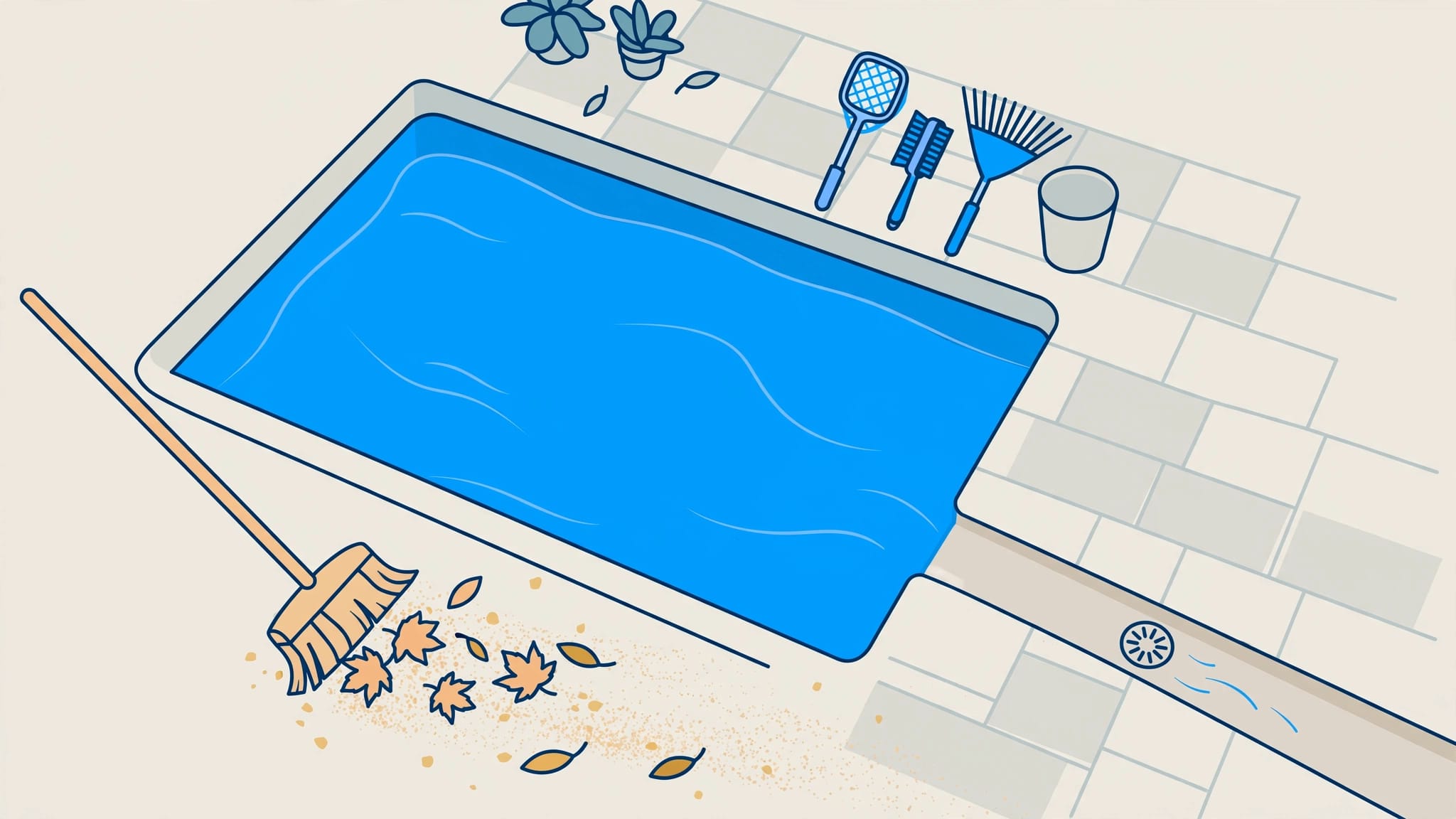
Keeping pool water clear during deck cleaning starts with controlling runoff. I recommend removing loose debris first, directing washwater away from the pool, and testing the water before and after the work.
Dirt, joint sand, sunscreen, and cleaning residue can affect pool water clarity. The priority is keeping contamination out, rather than adding chemicals afterward.
Start with the deck, drainage, and nearby surfaces before any cleaning begins.
Key Takeaways
- Sweep or collect dry debris before rinsing, and keep dirty washwater away from the pool.
- Test water chemistry before choosing clarifier, flocculant, or shock.
- Keep the filter operating properly, but switch the pump off during a flocculant settling period.
Protect the Pool Before Cleaning the Deck
Remove debris and plan the runoff
I recommend moving furniture, toys, and planters before cleaning. Collect leaves, loose sand, and other dry debris instead of washing everything toward the pool.
Inspect the deck for loose pavers, thin joints, cracks, and low spots. Excessive pressure can displace joint sand and send it straight into the water. Our guidance on pressure washing a pool deck safely covers why surface condition matters.
Keep deck drains clear. Where washwater could enter the pool, use suitable containment and wet-recovery equipment. Don’t redirect chemical washwater into storm drains or planting beds.
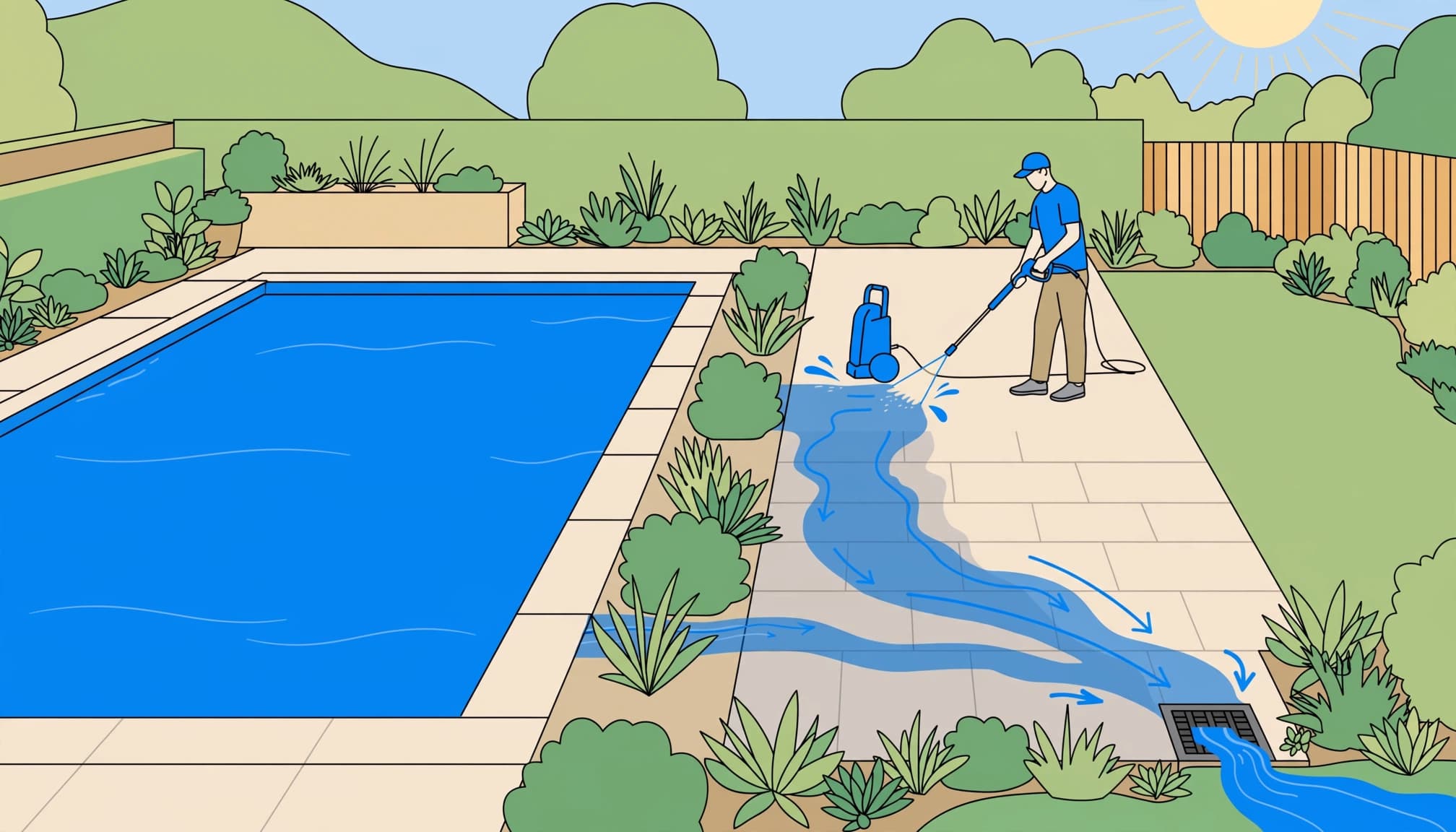
Control spray and cleaning residue
Use a surface-compatible cleaner and the least force needed to remove buildup. Test a small area first, especially on natural stone or previously sealed pavers.
Keep the spray directed away from the water. Never mix cleaning products or allow deck cleaner to enter pool chemical equipment.
Nearby screen and roof cleaning also need runoff control. A soft wash can remove organic growth with lower pressure, but its cleaning solution still belongs outside the pool.
If a substantial amount of cleaner, sealer, or oily residue enters the water, stop work and keep swimmers out. I recommend professional pool treatment rather than trying to hide contamination with clarifier.
Diagnose Pool Water Clarity Before Adding Chemicals
The appearance of the water helps narrow down the problem.
| Appearance | What it means | First response |
|---|---|---|
| Dull | Water lacks sparkle but remains transparent. | Inspect circulation and surface residue. |
| Hazy | The bottom remains visible through suspended particles. | Test chemistry and inspect filtration. |
| Cloudy | Water looks milky or opaque. | Keep swimmers out and investigate immediately. |
If cloudy pool water develops during deck cleaning, that cloudiness may point to introduced debris or residue. Cloudiness already present before cleaning deserves a separate chemistry and equipment assessment.
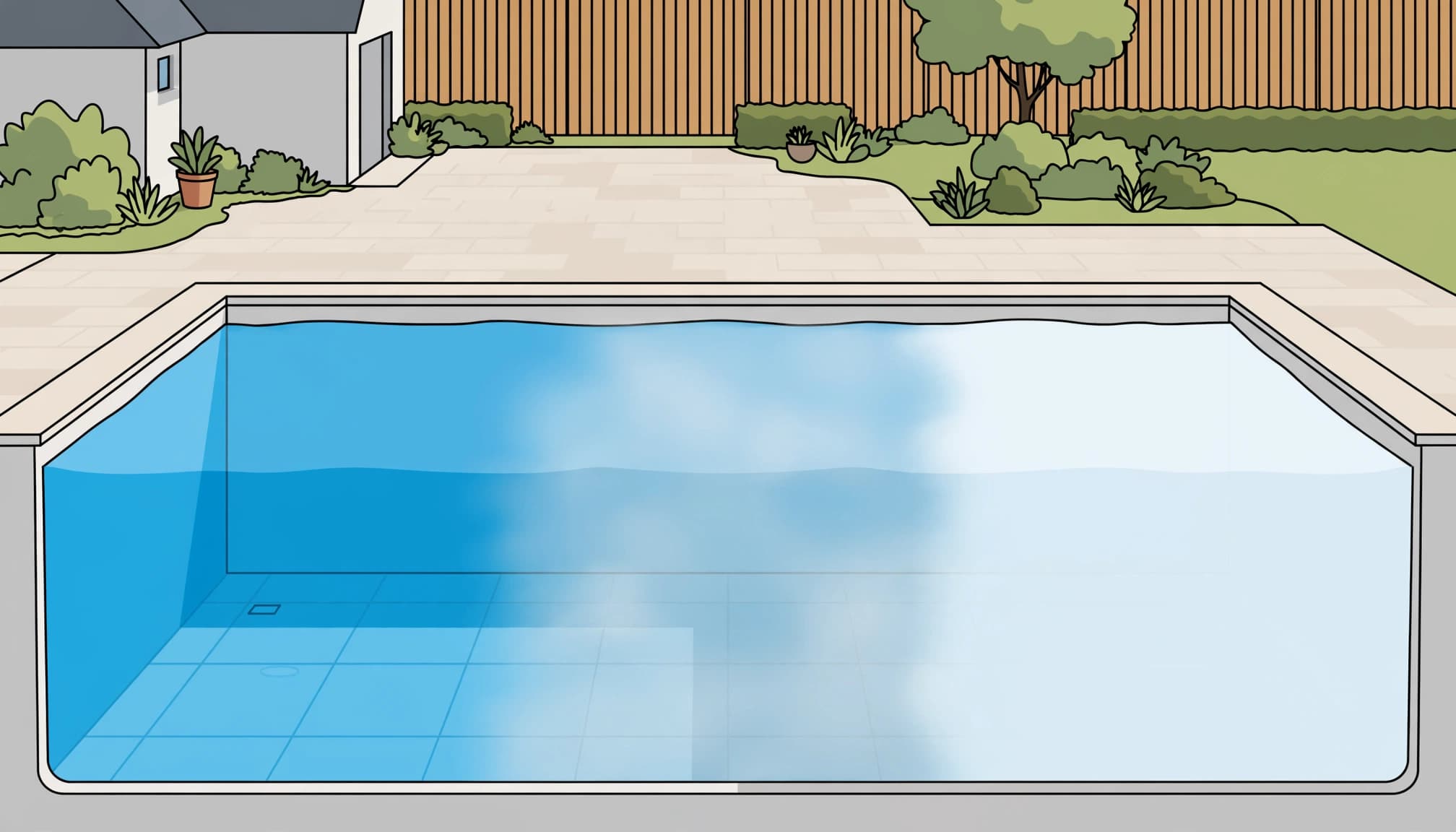
I recommend keeping everyone out whenever the bottom isn’t clearly visible. Clear visibility allows someone in trouble to be seen.
Commercial pool rules often require the main drain cover to remain visible from the deck. San Diego County’s swimming pool operator guidance includes that requirement.
A balanced test result doesn’t make opaque water safe. Visibility and sanitation both matter.
Test Water Chemistry Before Choosing a Treatment
Establish a reliable baseline
Test water chemistry before cleaning, after suspected contamination, and two or three times weekly during normal use. Residential pool troubleshooting guidance supports that regular testing schedule.
Test strips provide quick screening before and after deck cleaning. Test strips are useful for quick checks; record a stabilizer reading only if they measure it. For persistent cloudiness, I recommend a drop-based kit that measures free chlorine, combined chlorine, pH, alkalinity, and calcium hardness. A pool-store analysis can help when readings conflict.
Common operating targets are pH 7.2-7.6, total alkalinity 80-120 ppm, and free chlorine 1-4 ppm. Calcium hardness of 200-400 ppm suits many plaster pools, although requirements vary with the pool finish.
Correct chemistry in a controlled order
For a systematic correction, address alkalinity, calcium hardness, sanitizer, and then pH. Add products separately, allow circulation, and retest pH between adjustments.
Alkalinity above 120 ppm can make pH resist correction and trend upward. Repeatedly adding pH reducer without addressing alkalinity can leave you chasing the same problem.
Stabilizer matters, too. Pools using cyanuric acid need at least 2 ppm free chlorine, and the appropriate operating target depends on stabilizer concentration.
I wouldn’t add clarifier simply because the water looks dull. High pH, excess calcium, too little chlorine, and poor filtration require different corrections.
Choose Clarifier or Flocculant for Suspended Particles
The following are product-specific HTH dosing examples, not interchangeable instructions for every brand or concentration. The selected product’s label controls application.
Clarifier and flocculant doses vary with pool volume.
| Treatment | Per 10,000 gallons | Per 20,000 gallons |
|---|---|---|
| Clarifier for mild haze | 2 fl oz | 4 fl oz |
| Clarifier for extreme cloudiness | 4 fl oz | 8 fl oz |
| Flocculant | 8 fl oz | 16 fl oz |
Measure the actual pool volume. Extra product won’t reliably speed clearing and can create more problems.
Use a pool clarifier when the filter can collect particles
Clarifier combines small particles so the filter can capture them. Distribute it around the perimeter; use the skimmer only when the product label directs that method.
Run filtration continuously until clear. Avoid backwashing for at least 24 hours after treatment unless unsafe pressure requires servicing the filter.
Expect improvement over roughly 24-48 hours with balanced water and effective filtration. If the water hasn’t cleared within 48 hours, inspect filter cleanliness, circulation, and chemistry before adding another dose.
Use flocculant only with vacuum-to-waste capability
For the dosing example above, add flocculant with the pump running, circulate for two hours, then switch it off. Let particles settle undisturbed for 8-12 hours.
Vacuum slowly to waste, keeping the head close to the floor. Don’t brush or make quick movements that stir the settled material.
Sending flocculated debris through the filter can cause problems and return particles to the water. Above-ground pools without vacuum-to-waste capability should use a compatible clarifier instead of flocculant.
Use Shock and Filtration for the Right Problems
Shock treats sanitation problems, not deck residue
Shock can help when low sanitizer, organic contamination, or algae causes cloudiness. It won’t remove sand, correct high calcium, or make cleaning chemicals safe.
For the HTH formulation using a standard bag per 13,500 gallons, the routine weekly dose is one bag. The cloudy-water treatment is double that amount, or two bags per 13,500 gallons. Bag size and active ingredient vary across products, so these numbers aren’t universal.
Keep the pump running continuously during recovery to maintain filtration. Don’t swim until the water is clear and free chlorine returns to 1-4 ppm, while still meeting the minimum appropriate for the stabilizer level and product directions.
Give the filter enough time and attention
Run the pump at least eight hours daily as a starting point. Some pools need longer because of equipment capacity, weather, or swimmer load.
Empty baskets and inspect return flow. Persistent cloudiness with balanced chemistry often points toward restricted circulation, dirty media, damaged cartridges, or incorrect assembly.
Backwashing alone doesn’t reliably remove sunscreen, oils, algae residue, and scale. A compatible filter cleaner two or three times per season can help, depending on conditions.
Cartridges commonly last three to five years. Inspect sand media after about five years for buildup, channeling, or worn grains. Age alone doesn’t prove sand has stopped filtering.
New cloudiness after shocking or adding cyanuric acid can be temporary. With balanced chemistry and effective filtration from a clean, functioning filter, it often improves within a day or two. Persistent cloudiness needs investigation.
Prevent Another Cloudy-Water Cleanup
I recommend inspecting the pool and deck together after cleaning. Skim floating debris, remove settled material with suitable equipment, and retest the water.
Look for washed-out joints, recurring puddles, and drainage toward the pool. Cleaning without correcting those conditions leaves the same contamination route open.
Florida rain can introduce fresh debris and dilute pool chemistry. A post-rain pool inspection helps identify those changes before swimming resumes.
For the deck, remove sunscreen residue, leaves, and organic buildup before they become established. Our Southwest Florida paver maintenance calendar provides a practical seasonal routine.
As with driveway sealing, pool-deck sealing belongs after cleaning, repairs, and adequate drying. A compatible sealer can reduce absorption and simplify maintenance, but it won’t replace drainage or routine cleaning.
Call a pool professional when contamination is substantial, algae persists, or visibility doesn’t improve despite correct chemistry and filtration.
Frequently Asked Questions
Will baking soda clarify pool water?
Baking soda raises total alkalinity. It doesn’t collect suspended dirt or replace sanitizer and filtration.
I recommend using it only when testing shows low alkalinity. Adding it to already-high alkalinity can make pH management harder and contribute to cloudy conditions.
Why is the pool cloudy when chlorine is high?
Cloudy pool water can still come from suspended debris, calcium precipitation, poor filtration, or dead algae after treatment, even when chlorine is high. Cleaning runoff can also remain suspended when sanitizer readings are adequate.
Start with pH, calcium hardness, stabilizer, filter condition, and circulation instead of adding more shock automatically.
Should balanced but cloudy water get clarifier or flocculant?
For fine suspended particles, I generally recommend a filter-compatible pool clarifier first. Flocculant suits heavier cloudiness when the equipment can vacuum settled debris to waste.
Clarifier and flocculant products won’t repair a damaged filter or safely resolve unknown deck-cleaner contamination. Those problems need attention before treatment.
Protect the Water While Restoring the Deck
A clean deck shouldn’t leave you with a cloudy pool. I recommend starting with runoff control, then using test results and equipment condition to guide any treatment.
Careful cleaning protects the pavers, joints, and swimming water together. If your deck needs professional cleaning or sealing, you can Get a Quote for a free estimate.